Identity theft has become one of the fastest-growing financial crimes in the United States. Large data breaches, phishing scams, stolen Social Security numbers, and online fraud have exposed the personal information of millions of consumers. Even people who carefully manage their finances can become victims if criminals obtain enough personal information to apply for credit in their name.
One of the most effective ways to reduce the risk of new fraudulent credit accounts is by placing a credit freeze, also known as a security freeze, on your credit reports.
Although many consumers have heard the term, they often misunderstand what a credit freeze actually does.
Some believe freezing their credit will lower their credit score.
Others think it prevents them from using their existing credit cards.
Some even assume it permanently locks their credit reports and makes borrowing impossible.
Fortunately, none of these common misconceptions are true.
A credit freeze is a security tool designed to help protect your identity—not to limit your ability to manage your finances. When your credit is frozen, most lenders cannot access your credit report when evaluating a new credit application. Since many lenders rely on your credit report before approving new accounts, restricting access makes it significantly more difficult for identity thieves to open credit in your name.
This protection has become increasingly valuable as identity theft has become more sophisticated.
Criminals may use stolen personal information to apply for:
- Credit cards
- Personal loans
- Auto loans
- Retail financing
- Lines of credit
- Other financial products
Without a credit freeze, these applications may be approved before the victim even realizes their identity has been compromised.
It’s also important to understand the difference between protecting your credit and protecting your credit score.
Your credit score measures your creditworthiness based on information contained in your credit reports.
A credit freeze, however, protects access to your credit reports, making it harder for unauthorized individuals to establish new credit using your identity.
In other words:
- A credit score helps lenders evaluate risk.
- A credit freeze helps reduce the risk of identity theft.
These are two different concepts that work together to protect your financial health.
Not everyone needs to freeze their credit immediately, but there are situations where it may be an excellent precaution.
For example, you may want to consider a credit freeze if:
- Your personal information was exposed during a data breach.
- Your Social Security number may have been stolen.
- You suspect identity theft.
- Your wallet containing important identification was lost or stolen.
- You discover unfamiliar accounts or inquiries on your credit report.
- You simply want additional protection against future fraud.
Many financial experts recommend considering a credit freeze after major data breaches because stolen personal information may remain useful to criminals for years.
One advantage of a credit freeze is that it does not interfere with your existing financial accounts.
You can continue to:
- Use your credit cards.
- Make loan payments.
- Receive statements.
- Pay your mortgage.
- Build positive payment history.
The freeze primarily affects new credit applications, not the accounts you already have.
Throughout this guide, you’ll learn exactly what a credit freeze is, how it works, whether it affects your credit score, and when freezing your credit may be one of the smartest steps you can take to protect your financial future.
Featured Snippet
What is a credit freeze?
A credit freeze, also known as a security freeze, restricts access to your credit report, making it more difficult for identity thieves to open new credit accounts in your name. A credit freeze does not affect your credit score, and you can temporarily lift or permanently remove it whenever you need to apply for new credit.
What Is a Credit Freeze?
A credit freeze is a security measure that limits who can access your credit report.
When a freeze is in place, most lenders cannot obtain your credit report to evaluate applications for new credit. Because many lenders require access to your credit report before approving loans or credit cards, restricting access helps reduce the likelihood that someone can successfully open new accounts using your identity.
A credit freeze is sometimes called a security freeze because its primary purpose is to protect consumers from identity theft and unauthorized credit activity.
It does not erase your credit history, change your credit score, or close any of your existing accounts.
Instead, it adds an additional layer of security around your credit information.
Why Does a Credit Freeze Exist?
Credit freezes were created to help consumers protect themselves from identity theft.
In today’s digital world, personal information may be exposed through:
- Data breaches.
- Phishing scams.
- Mail theft.
- Lost wallets.
- Stolen documents.
- Online fraud.
- Hacked accounts.
If criminals obtain enough identifying information, they may attempt to open new credit accounts using someone else’s identity.
A credit freeze makes that process much more difficult because lenders generally cannot access the frozen credit report required to evaluate the application.
Although no security measure can eliminate every form of fraud, a credit freeze is considered one of the strongest protections against unauthorized new credit accounts.
How Does a Credit Freeze Protect Consumers?
A credit freeze helps protect consumers by limiting access to one of the most important pieces of information lenders use during the approval process: the credit report.
Without access to your credit report, many lenders may be unable to complete their normal underwriting process for new credit applications.
This means identity thieves often face an additional barrier if they attempt to:
- Open credit cards.
- Obtain personal loans.
- Finance vehicles.
- Apply for retail financing.
- Establish new lines of credit.
While a freeze cannot stop every type of fraud, it can significantly reduce the risk of new fraudulent credit accounts being opened in your name.
Who Can Place a Credit Freeze?
Most consumers can request a credit freeze on their own credit reports.
Depending on applicable laws and circumstances, parents or legal guardians may also be able to request freezes for eligible minor children or protected individuals.
The freeze generally remains in place until you choose to temporarily lift or permanently remove it.
This gives consumers ongoing control over access to their credit reports.
How Does a Credit Freeze Work?
Understanding how a credit freeze works helps eliminate many common misconceptions.
A freeze does not block access to all financial information.
Instead, it specifically restricts access to your credit report for most new credit applications.
Credit Bureaus Restrict Access
When you place a security freeze, the nationwide credit bureau receiving your request restricts access to your credit report.
Because lenders typically review credit reports before approving new accounts, the freeze limits their ability to evaluate applications submitted in your name.
For maximum protection, consumers generally place freezes with all three nationwide credit bureaus.
Most Lenders Cannot Review Frozen Reports
When you apply for new credit, lenders usually request your credit report from one or more nationwide credit bureaus.
If your report is frozen, the lender may be unable to access it.
Without that information, the lender may delay processing or decline to approve the new application until access becomes available.
This is exactly how the freeze helps reduce identity theft.
Even if someone has your personal information, they may be unable to obtain new credit if the lender cannot review your frozen report.
Most New Credit Applications Require Lifting the Freeze First
If you decide to apply for a loan, mortgage, credit card, or other financing, you can temporarily lift your credit freeze before submitting your application.
Once the lender completes its review, you can choose to have the freeze continue protecting your credit reports.
This flexibility allows consumers to balance strong identity protection with the ability to apply for credit whenever necessary.
Existing Accounts Continue to Function Normally
One of the biggest myths about credit freezes is that they prevent consumers from using their current credit cards or loans.
They do not.
A credit freeze generally does not interfere with:
- Existing credit card accounts.
- Mortgage payments.
- Auto loans.
- Personal loans.
- Student loans.
- Scheduled payments.
- Available credit limits.
You can continue using your existing financial accounts exactly as you did before placing the freeze.
Does a Credit Freeze Affect Your Credit Score?
One of the most frequently asked questions is whether freezing your credit causes your credit score to decrease.
The answer is no.
A credit freeze does not directly affect your credit score.
Your score continues to be calculated using the information contained in your credit report, including factors such as payment history, credit utilization, account age, and other information used by the applicable scoring model.
Simply restricting access to your report does not change any of those factors.
No Impact on Credit Scores
Placing, lifting, or removing a credit freeze does not directly increase or decrease your credit score.
Your credit score continues to change only as your credit information changes over time.
No Impact on Existing Loans
Your current lenders can generally continue servicing your existing accounts.
You’ll still make:
- Mortgage payments.
- Auto loan payments.
- Student loan payments.
- Personal loan payments.
The freeze does not interrupt these relationships.
No Impact on Credit Card Use
You can continue using your credit cards normally.
Purchases, payments, rewards, available credit, and statements continue functioning just as they did before the freeze.
No Impact on Payment History
Your positive payment history continues to be reported according to your lenders’ reporting practices.
Likewise, missed payments—if they occur—may still be reported.
The freeze simply restricts access for most new credit applications.
It does not stop normal account reporting.
Real-Life Example
Maria receives a notification that her personal information may have been exposed during a large data breach involving an online service she used. Concerned that someone could attempt to open new credit accounts using her identity, she decides to place a security freeze with the nationwide credit bureaus.
Over the following months, Maria continues using her existing credit cards, pays her auto loan on time, and monitors her credit reports. Her daily banking and borrowing activities continue without interruption because the freeze does not affect her current accounts.
Several months later, Maria decides to finance a new vehicle. Before submitting her auto loan application, she temporarily lifts the credit freeze so the lender can review her credit report. Once the application process is complete, she restores the freeze to continue protecting her credit information against unauthorized applications.
Maria’s experience illustrates how a credit freeze can provide ongoing identity theft protection while still allowing consumers to access new credit when they choose.
Key Takeaway
A credit freeze, also known as a security freeze, is one of the most effective tools available for helping protect against identity theft involving new credit accounts. By restricting access to your credit report, it makes it more difficult for unauthorized individuals to open loans or credit cards in your name.
Importantly, a credit freeze does not affect your credit score, close your existing accounts, prevent you from using your credit cards, or stop your lenders from reporting payment history. It simply adds an additional layer of protection around your credit information. If you later need to apply for new financing, you can temporarily lift the freeze and restore it afterward.
When Should You Freeze Your Credit? How to Place, Lift, and Remove a Credit Freeze
In Part 1, you learned that a credit freeze is one of the strongest tools available to help protect yourself from identity theft. You also learned that it does not lower your credit score or interfere with your existing credit accounts.
The next question many consumers ask is:
Should I freeze my credit right now?
The answer depends on your personal circumstances. While a credit freeze is available to almost every consumer in the United States, it isn’t something every person needs immediately. However, there are situations where placing a freeze can provide significant peace of mind and financial protection.
In this section, you’ll learn when a credit freeze makes sense, how to place one with each of the three nationwide credit bureaus, how long it lasts, and how easy it is to temporarily lift or permanently remove it when you’re ready to apply for credit.
When Should You Consider Freezing Your Credit?
There is no single rule that applies to everyone.
Some consumers never experience identity theft and may rarely think about their credit reports. Others have their personal information exposed during a data breach or discover suspicious activity on their accounts and decide that freezing their credit is the safest option.
Generally, you should strongly consider placing a credit freeze if your personal information may have been compromised or if you simply want to reduce the risk of someone opening new accounts in your name.
Below are some of the most common situations where a credit freeze may be appropriate.
After a Data Breach
Large companies, healthcare providers, retailers, financial institutions, and government agencies occasionally experience data breaches that expose customer information.
The information exposed may include:
- Social Security numbers
- Dates of birth
- Driver’s license numbers
- Addresses
- Email addresses
- Financial account information
Even if criminals don’t use this information immediately, stolen data can circulate online for years.
Placing a credit freeze after a major breach helps reduce the likelihood that someone can use your information to open new credit accounts.
If Your Identity Has Been Stolen
If you know—or strongly suspect—that someone has stolen your identity, placing a credit freeze should be one of your highest priorities.
Signs of identity theft may include:
- Credit cards you never applied for
- Collection notices for unfamiliar accounts
- New loan approvals you didn’t request
- Unknown hard inquiries on your credit report
- Bills for accounts you don’t recognize
A freeze can help prevent additional fraudulent credit accounts while you work through the recovery process.
If Your Social Security Number Has Been Exposed
Your Social Security number is one of the most valuable pieces of information identity thieves seek.
If you discover your Social Security number has been exposed, lost, or stolen, freezing your credit can provide an important layer of protection while you monitor your financial accounts.
If You Rarely Apply for New Credit
Many consumers go years without applying for:
- Credit cards
- Mortgages
- Auto loans
- Personal loans
- Retail financing
If you have no immediate borrowing plans, keeping your credit frozen most of the time may be a sensible precaution because you lose very little convenience while gaining additional protection.
If You Simply Want Extra Security
Some consumers freeze their credit even though they’ve never been victims of fraud.
Much like locking your front door before leaving home, placing a credit freeze is a preventive security measure.
Many financial experts recommend this approach because identity theft often occurs without warning.
When Might You Not Need a Credit Freeze Right Away?
Although a credit freeze offers strong protection, it may not always be the most practical option.
For example, you may be applying for several financial products over the next few months, such as:
- A mortgage
- An auto loan
- Student financing
- Multiple credit cards
In these situations, repeatedly lifting and refreezing your credit reports may become inconvenient.
Some consumers instead choose to wait until their borrowing needs have been completed before placing a freeze.
The decision depends on your personal financial circumstances and your level of concern about identity theft.
How to Place a Credit Freeze
Placing a credit freeze is generally a straightforward process.
Because lenders may obtain reports from different nationwide credit bureaus, many experts recommend placing a freeze with all three major credit bureaus for the strongest protection.
These nationwide credit bureaus are:
- Equifax
- Experian
- TransUnion
Each bureau manages its own credit reports independently.
This means placing a freeze with one bureau does not automatically freeze your reports with the other two.
You’ll generally need to submit a separate request to each bureau.
The bureaus typically verify your identity before activating the freeze.
Verification may include confirming information such as:
- Your name
- Date of birth
- Social Security number
- Address history
- Other identifying information
Once your identity is verified, the freeze is placed on your credit report.
Many consumers create secure online accounts with each bureau to make future management easier.
How Long Does a Credit Freeze Last?
One of the biggest advantages of a security freeze is that it remains in place until you decide otherwise.
Unlike some temporary fraud protections, a credit freeze does not automatically expire after a certain number of months.
It generally remains active until you choose to:
- Temporarily lift it
- Permanently remove it
This allows you to keep your credit reports protected for as long as you believe necessary.
How to Temporarily Lift a Credit Freeze
Eventually, you may want to apply for:
- A mortgage
- An auto loan
- A personal loan
- A new credit card
- Apartment rental screening
- Certain employment background checks that involve credit reports
Before the lender can review your frozen report, you’ll usually need to temporarily lift the freeze with the appropriate credit bureau.
A temporary lift allows access for a specific period of time or, in some cases, for a specific creditor.
After the lender finishes reviewing your report, the freeze can remain in place automatically if you selected a temporary lift.
This flexibility allows consumers to continue protecting their credit while still applying for financing when necessary.
How to Permanently Remove a Credit Freeze
If you no longer want your credit frozen, you can request permanent removal.
Once removed, lenders can generally access your credit reports during future credit applications without additional action from you.
Some consumers remove freezes permanently because they frequently apply for credit, while others prefer keeping the freeze active and lifting it only when needed.
Neither approach is universally better.
The best option depends on your borrowing habits and comfort level with identity theft risks.
Can Parents Freeze a Child’s Credit?
Many parents are surprised to learn that children can also become victims of identity theft.
Because children typically do not monitor credit reports or apply for loans, fraudulent activity may go unnoticed for years.
In many situations, parents or legal guardians may be able to request a security freeze for an eligible minor child’s credit report.
This can help prevent identity thieves from opening fraudulent accounts using the child’s personal information before they become adults.
Requirements may differ depending on the credit bureau and applicable law, so parents should review each bureau’s procedures before submitting a request.
Consumer Protections Under U.S. Law
Credit freezes are supported by federal law and are designed to give consumers greater control over access to their credit reports.
Consumers generally have the right to:
- Request a credit freeze.
- Temporarily lift the freeze.
- Permanently remove the freeze.
- Manage their freeze directly with each nationwide credit bureau.
These protections help reduce the financial damage identity thieves may cause when attempting to establish new credit accounts using stolen personal information.
Although a credit freeze is one of the strongest identity protection tools available, it should still be combined with good financial security habits, including:
- Monitoring your credit reports regularly.
- Using strong passwords.
- Enabling multi-factor authentication.
- Watching for unfamiliar financial activity.
- Responding quickly to suspicious account notices.
A layered approach provides stronger protection than relying on any single security measure alone.
Key Takeaway
A credit freeze is most valuable when you’re concerned about identity theft or simply want stronger protection for your personal information. It can be especially useful after a data breach, if your Social Security number has been exposed, or if you rarely apply for new credit. For the strongest protection, place a freeze with Equifax, Experian, and TransUnion, since each bureau manages its own credit reports. A freeze remains in effect until you choose to temporarily lift or permanently remove it, giving you long-term control over who can access your credit information.
Credit Freeze vs. Fraud Alert vs. Credit Lock
In Parts 1 and 2, you learned what a credit freeze is, how it works, and when it may be appropriate to place one. However, a credit freeze is only one of several tools available to help protect your personal information and credit history.
Consumers also hear about fraud alerts and credit locks, and many assume these terms all mean the same thing.
They don’t.
Although all three are designed to help reduce the risk of identity theft, they work in different ways and provide different levels of protection.
Understanding these differences can help you choose the option that best fits your financial situation and security needs.
In this section, you’ll learn how credit freezes, fraud alerts, and credit locks compare, the advantages and disadvantages of each, common myths about credit freezes, whether a freeze protects your existing accounts, when a fraud alert may be a better choice, and practical steps to take after a data breach.
Credit Freeze vs. Fraud Alert vs. Credit Lock
These three identity protection tools all aim to reduce fraud, but they operate differently.
What Is a Credit Freeze?
A credit freeze, also known as a security freeze, restricts access to your credit report.
When most lenders cannot review your credit report, it becomes much harder for identity thieves to open new credit accounts in your name.
A credit freeze generally remains in place until you choose to temporarily lift or permanently remove it.
It is widely considered one of the strongest protections against new account identity theft.
What Is a Fraud Alert?
A fraud alert is a notice placed on your credit report telling lenders that they should take extra steps to verify your identity before approving new credit.
Unlike a credit freeze, lenders can still access your credit report.
However, the alert encourages them to confirm that the person applying for credit is really you before extending credit.
Fraud alerts may be appropriate if:
- You believe your information has been exposed.
- Your wallet or identification has been stolen.
- You suspect someone may attempt to use your identity.
- You’re concerned about fraud but don’t want to freeze your credit.
Because lenders can still access your report, a fraud alert is generally less restrictive than a credit freeze.
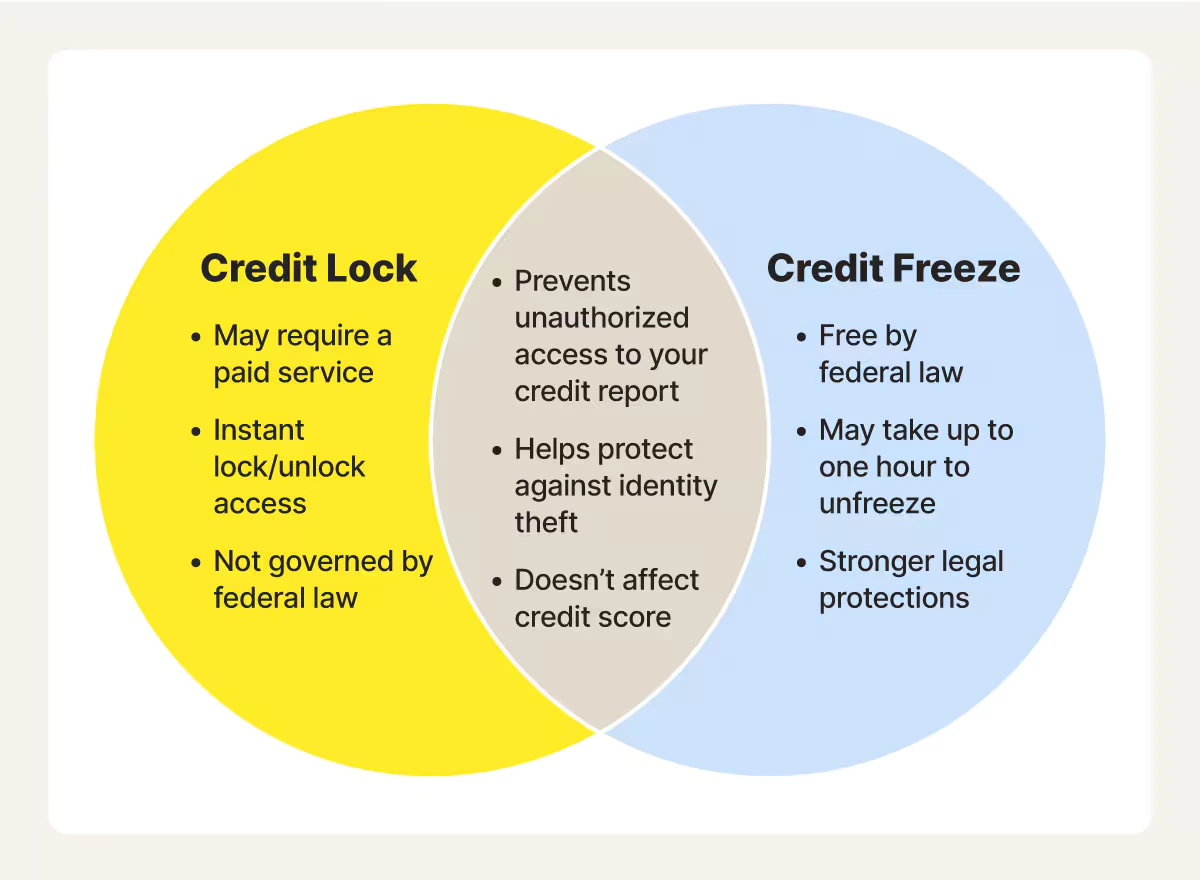
What Is a Credit Lock?
A credit lock is similar to a credit freeze because it also limits access to your credit report.
However, a credit lock is generally offered as a commercial product or service by individual credit bureaus.
Unlike a security freeze, which is protected under federal law, a credit lock is typically governed by the provider’s own terms and conditions.
Some consumers prefer credit locks because they may allow faster activation and removal through mobile apps or online accounts.
Others prefer credit freezes because they are established under consumer protection laws.
Comparison at a Glance
| Feature | Credit Freeze | Fraud Alert | Credit Lock |
|---|---|---|---|
| Restricts access to your credit report | ✔ Yes | ✘ No | ✔ Usually |
| Lenders can review your report | Usually no | Yes | Usually no |
| Helps prevent new fraudulent accounts | ✔ Strongly | ✔ Moderately | ✔ Strongly |
| Affects your credit score | ✘ No | ✘ No | ✘ No |
| Existing accounts continue working | ✔ Yes | ✔ Yes | ✔ Yes |
| Can be lifted when applying for credit | ✔ Yes | Usually not necessary | ✔ Yes |
Advantages of a Credit Freeze
A credit freeze offers several important benefits.
Strong Protection Against Identity Theft
Because most lenders cannot access your credit report, identity thieves often cannot successfully open new accounts using your information.
No Effect on Your Credit Score
Many consumers hesitate because they worry their credit score will decrease.
Fortunately, placing, lifting, or removing a freeze does not affect your credit score.
Long-Term Protection
A freeze remains in place until you choose to remove it.
This allows consumers to keep their credit reports protected for years if they wish.
Existing Accounts Continue Normally
Your:
- Credit cards
- Mortgage
- Auto loan
- Student loans
- Personal loans
continue operating normally.
Disadvantages of a Credit Freeze
Although highly effective, credit freezes are not perfect.
You Must Lift the Freeze Before Applying for New Credit
If you apply for:
- A mortgage
- A new credit card
- An auto loan
- A personal loan
you’ll usually need to temporarily lift the freeze first.
Although this process is generally straightforward, it does require planning.
It Does Not Stop Every Type of Fraud
A credit freeze primarily helps prevent new account fraud.
It does not prevent someone from:
- Using an existing stolen credit card.
- Taking over an existing account.
- Filing fraudulent tax returns.
- Committing other forms of identity theft unrelated to opening new credit.
For this reason, consumers should continue monitoring financial accounts even after freezing their credit.
Common Myths About Credit Freezes
Many misconceptions discourage consumers from using credit freezes.
Let’s separate fact from fiction.
Myth: A Credit Freeze Lowers Your Credit Score
Fact:
A credit freeze has no effect on your credit score.
Myth: You Cannot Use Your Credit Cards
Fact:
You can continue using all of your existing credit cards normally.
Myth: Your Loans Will Stop Working
Fact:
Existing mortgages, auto loans, student loans, and personal loans continue as usual.
Myth: A Credit Freeze Prevents Identity Theft Completely
Fact:
A freeze is one of the strongest protections against new credit account fraud, but it does not stop every type of identity theft.
Consumers should continue reviewing their credit reports and financial statements regularly.
Myth: Freezing Your Credit Means You’ll Never Get Approved Again
Fact:
You simply lift the freeze before applying for new credit and restore it afterward if you choose.
Does a Credit Freeze Protect Existing Accounts?
This is another common misunderstanding.
A credit freeze primarily protects against new credit accounts being opened without your authorization.
It generally does not protect your current accounts from fraud.
For example, a freeze will not stop someone who has already stolen your credit card number from attempting unauthorized purchases.
Likewise, it won’t prevent account takeover if someone gains access to your online banking credentials.
To protect existing accounts, consumers should also:
- Use strong passwords.
- Enable multi-factor authentication.
- Monitor account activity regularly.
- Report suspicious transactions immediately.
- Replace compromised cards when necessary.
A credit freeze is an important layer of protection—but it works best as part of a broader identity protection strategy.
When Might a Fraud Alert Be a Better Choice?
Although credit freezes offer stronger protection against new account fraud, there are situations where a fraud alert may be more convenient.
For example:
- You’re actively shopping for a mortgage.
- You’re applying for several credit cards.
- You’re financing a vehicle.
- You expect multiple lenders to review your credit reports.
Because lenders can still access your report while a fraud alert is active, you generally won’t need to repeatedly lift and replace a freeze during the application process.
Some consumers choose a fraud alert temporarily while shopping for credit and later place a credit freeze after completing their borrowing.
The right option depends on your circumstances, convenience, and comfort level with risk.
Best Practices After a Data Breach
If you learn that your personal information has been exposed in a data breach, acting quickly can reduce your risk of identity theft.
Consider taking the following steps:
- Review the breach notification carefully.
- Change passwords for affected accounts.
- Enable multi-factor authentication wherever possible.
- Review your bank and credit card statements for unauthorized activity.
- Obtain copies of your credit reports and review them for unfamiliar accounts or inquiries.
- Consider placing a credit freeze if your Social Security number or other sensitive information was exposed.
- Continue monitoring your financial accounts regularly.
- Be cautious of phishing emails or phone calls claiming to help with the breach.
- Report suspicious activity promptly.
- Keep documentation related to the breach in case you need it later.
Responding promptly after a data breach can help reduce the likelihood of long-term financial harm.
Key Takeaway
A credit freeze, fraud alert, and credit lock all help protect against identity theft, but they work differently. A credit freeze offers the strongest protection by restricting access to your credit report, while a fraud alert asks lenders to verify your identity before approving new credit. A credit lock functions similarly to a freeze but is generally offered under a credit bureau’s service terms rather than federal law. Regardless of which option you choose, remember that none of these tools protects existing accounts from every type of fraud. The best defense combines identity protection tools with regular credit report reviews, account monitoring, strong passwords, and prompt action after any suspected data breach.
Frequently Asked Questions, Identity Protection Tips, and Next Steps
A credit freeze is one of the strongest tools available for protecting yourself against new account identity theft. However, it works best when combined with other good financial habits, such as reviewing your credit reports regularly, monitoring your financial accounts, using strong passwords, and responding quickly to suspicious activity.
Whether you’ve already placed a security freeze or are still deciding if it’s the right choice, understanding how credit freezes work can help you make informed decisions about protecting your personal information.
In this final section, you’ll find answers to common questions, practical identity protection tips, trusted U.S. resources, and additional Clear Money Steps guides to help you strengthen your financial security.
Frequently Asked Questions (FAQs)
1. What is a credit freeze?
A credit freeze, also known as a security freeze, restricts access to your credit report, making it more difficult for identity thieves to open new credit accounts in your name.
2. Does a credit freeze affect my credit score?
No. Placing, lifting, or removing a credit freeze does not affect your credit score.
3. Can I still use my credit cards if my credit is frozen?
Yes. Existing credit cards continue working normally.
4. Will my mortgage or auto loan be affected?
No. Existing loans continue exactly as before.
5. Can I still make purchases with my credit card?
Yes. A credit freeze does not limit purchases or payments on existing accounts.
6. How long does a credit freeze last?
A credit freeze generally remains in place until you choose to temporarily lift or permanently remove it.
7. Can I temporarily lift my credit freeze?
Yes. You can temporarily lift a freeze when you need a lender to review your credit report.
8. Can I permanently remove my credit freeze?
Yes. You may remove it whenever you decide you no longer want the protection.
9. Should I freeze my credit after a data breach?
If sensitive personal information—such as your Social Security number—has been exposed, a credit freeze may be a sensible way to reduce the risk of unauthorized new credit accounts.
10. Does a credit freeze prevent identity theft completely?
No. A credit freeze primarily helps prevent new account fraud. It does not stop every form of identity theft.
11. What’s the difference between a credit freeze and a fraud alert?
A credit freeze restricts access to your credit report, while a fraud alert encourages lenders to verify your identity before approving new credit.
12. What’s the difference between a credit freeze and a credit lock?
Both limit access to your credit report, but a credit freeze is established under federal law, while a credit lock is generally offered under a credit bureau’s service terms.
13. Should I freeze my credit with all three credit bureaus?
Yes. Because lenders may obtain reports from different nationwide credit bureaus, freezing all three reports generally provides the strongest protection.
14. Can parents freeze a child’s credit?
In many situations, parents or legal guardians may request a credit freeze for an eligible minor child’s credit report, subject to each bureau’s requirements.
15. Can lenders still see my credit report?
Most lenders cannot access a frozen report for new credit applications unless you temporarily lift the freeze.
16. Can employers still conduct background checks?
Certain employers may request permission to review credit information where permitted by law. Requirements vary depending on the employer and applicable laws.
17. Will a credit freeze stop my current lenders from reporting payments?
No. Your existing lenders can generally continue reporting account information according to their normal reporting practices.
18. Does freezing my credit improve my credit score?
No. A credit freeze protects your credit reports but does not directly increase or decrease your credit score.
19. Is a credit freeze free?
Under current U.S. federal law, consumers can generally place, temporarily lift, and remove security freezes without paying a fee. However, it’s always wise to verify current policies directly with the nationwide credit bureaus.
20. What’s the best way to protect my identity?
A credit freeze is an excellent security tool, but it works best alongside regular credit report reviews, account monitoring, strong passwords, multi-factor authentication, and prompt responses to suspicious activity.
Myths vs. Facts
| Myth | Fact |
|---|---|
| A credit freeze lowers your credit score. | A credit freeze has no effect on your credit score. |
| You can’t use your credit cards after freezing your credit. | Existing credit cards continue working normally. |
| A credit freeze closes your accounts. | Existing accounts remain open and continue operating normally. |
| A credit freeze prevents all identity theft. | It primarily helps prevent unauthorized new credit accounts. |
| You can never borrow money again after freezing your credit. | You can temporarily lift the freeze whenever you apply for new credit. |
| A fraud alert and a credit freeze are the same thing. | They are different identity protection tools with different functions. |
| Only identity theft victims should freeze their credit. | Many consumers choose a freeze as a preventive security measure. |
| One credit freeze protects all three credit bureaus automatically. | A separate request is generally required for each nationwide credit bureau. |
30-Day Identity Protection Plan
Week 1: Secure Your Credit
- Obtain your credit reports.
- Review your credit history for unfamiliar accounts.
- Decide whether a credit freeze is appropriate.
- Strengthen passwords on financial accounts.
Week 2: Improve Account Security
- Enable multi-factor authentication.
- Update security questions.
- Review bank account activity.
- Monitor credit card transactions.
Week 3: Review Your Financial Records
- Check loan accounts.
- Review credit inquiries.
- Confirm personal information is accurate.
- Watch for suspicious correspondence.
Week 4: Build Long-Term Protection
- Schedule regular credit report reviews.
- Continue monitoring financial accounts.
- Keep identity documents secure.
- Stay informed about new fraud prevention practices.
Beginner-Friendly Checklist
✔ Understand what a credit freeze does.
✔ Learn the difference between a credit freeze and a fraud alert.
✔ Review your credit reports regularly.
✔ Monitor your financial accounts.
✔ Use strong, unique passwords.
✔ Enable multi-factor authentication.
✔ Freeze your credit if appropriate for your situation.
✔ Lift your freeze before applying for new credit.
✔ Report suspicious activity promptly.
✔ Continue practicing good financial security habits.
When Should You Seek Professional Assistance?
Consider seeking help if you:
- Believe you’ve become a victim of identity theft.
- Discover fraudulent accounts on your credit reports.
- Need assistance disputing inaccurate information.
- Experience repeated unauthorized financial activity.
- Need personalized financial or legal guidance regarding identity theft recovery.
Depending on your situation, assistance may be available from financial institutions, nonprofit credit counseling organizations, consumer protection agencies, or legal professionals.
Continue Learning With Clear Money Steps
Continue building your financial knowledge with these related guides:
- How Often Should You Check Your Credit Report?
- How to Read Your Credit Report
- How to Dispute an Error on Your Credit Report
- Credit Score vs. Credit Report
- Does Checking Your Credit Score Hurt It?
- What Is a Thin Credit File?
- How to Build Credit From Scratch
- FICO® Score vs. VantageScore®
- How Often Does Your Credit Score Update?
- What Is a Good Credit Score?
These guides provide additional information to help you understand credit reporting, protect your identity, and make informed financial decisions.
Trusted U.S. Consumer Protection Resources
For accurate and up-to-date information, consult these trusted organizations:
- Consumer Financial Protection Bureau (CFPB) – Consumer education about credit reports, identity theft, and financial rights.
- Federal Trade Commission (FTC) – Identity theft reporting, fraud prevention, and consumer protection guidance.
- Equifax – Information about placing, lifting, and managing security freezes.
- Experian – Credit freeze resources and consumer education.
- TransUnion – Security freeze guidance and identity protection information.
- AnnualCreditReport.com – The official website for eligible free credit reports from the three nationwide credit bureaus.
Financial Disclaimer
The information in this article is provided for educational and informational purposes only and should not be considered financial, legal, tax, or identity theft recovery advice. Consumer protection laws, credit reporting practices, and financial products may change over time. If you believe you have become a victim of identity theft or need advice specific to your situation, consider consulting a qualified financial professional, legal advisor, or the appropriate consumer protection agency.
Conclusion
A credit freeze is one of the most effective ways to help protect yourself from new account identity theft. By restricting access to your credit reports, it makes it much more difficult for criminals to open loans or credit cards in your name while leaving your existing accounts, credit score, and payment history unaffected.
Although a credit freeze is a powerful security tool, it is not a complete identity theft solution. The strongest protection comes from combining a security freeze with regular credit report reviews, careful account monitoring, strong passwords, multi-factor authentication, and prompt action whenever suspicious activity appears.
Whether you’ve experienced a data breach, suspect identity theft, or simply want greater control over your personal information, understanding how credit freezes work can help you make informed decisions about protecting your financial future.
At Clear Money Steps, we’re committed to providing accurate, trustworthy, and easy-to-understand financial education. Our articles are reviewed regularly to reflect current U.S. consumer credit practices and are designed to help you build confidence, protect your identity, and make smarter financial decisions throughout every stage of your credit journey.
Table of Contents

Blessing Thagisa is a personal finance writer and researcher at Clear Money Steps, specializing in credit scores, credit reports, loans, budgeting, and consumer financial education. He is passionate about making complex financial topics easy to understand through accurate, practical, and well-researched guides. His goal is to help readers build strong financial habits, improve their credit, and make confident money decisions with clear, trustworthy information.