A Good Credit Score Can Save You Thousands
Imagine two people walk into the same car dealership on the same day.
They choose the exact same vehicle. The price is the same. The loan term is the same. Even the down payment is similar.
But when the financing offers arrive, the numbers look very different.
The first buyer is offered an interest rate of 4.9% APR.
The second buyer is offered 13.8% APR.
Same car. Same dealership. Very different monthly payments.
Why?
One of the biggest reasons may be their credit scores.
A lender may view the first buyer as a lower-risk borrower because of a stronger credit history. The second buyer may still qualify for financing, but the lender may charge a much higher interest rate to account for the additional risk.
That difference can become expensive very quickly.
For example, consider a $30,000 auto loan paid over 60 months:
| Interest Rate | Approximate Monthly Payment | Approximate Total Interest |
|---|---|---|
| 4.9% APR | $565 | $3,900 |
| 13.8% APR | $694 | $11,600 |
The borrower with the higher rate could pay roughly $129 more every month and about $7,700 more in interest over the life of the loan.
That is money that could have gone toward:
- Building an emergency fund
- Paying down other debt
- Saving for retirement
- Covering household expenses
- Investing for the future
This is why having good credit is not simply about earning a high score or having something to brag about.
A good credit score can affect how much borrowing costs you.
It may influence whether you qualify for a competitive mortgage, an affordable auto loan, a lower-cost credit card, or an apartment without a large security deposit. It can also affect the financial options available to you when you need them most.
However, there is no single score that guarantees approval or the lowest interest rate. Lenders also consider factors such as your income, current debt, down payment, employment history, and the type of loan you are applying for.
Still, understanding what counts as a good credit score is an important first step toward making smarter financial decisions.
In this guide, you will learn:
- What credit score ranges are generally considered good
- How FICO and VantageScore ranges differ
- Whether scores such as 650, 700, 750, and 800 are good
- What financial opportunities a stronger score may provide
- Why two people with the same score can receive different offers
- What steps may help you work toward better credit
Key takeaway: Good credit is not about status. It can reduce the cost of borrowing and potentially save you thousands of dollars over time.
What Is Considered a Good Credit Score?
One of the first questions many people ask is, “What is a good credit score?”
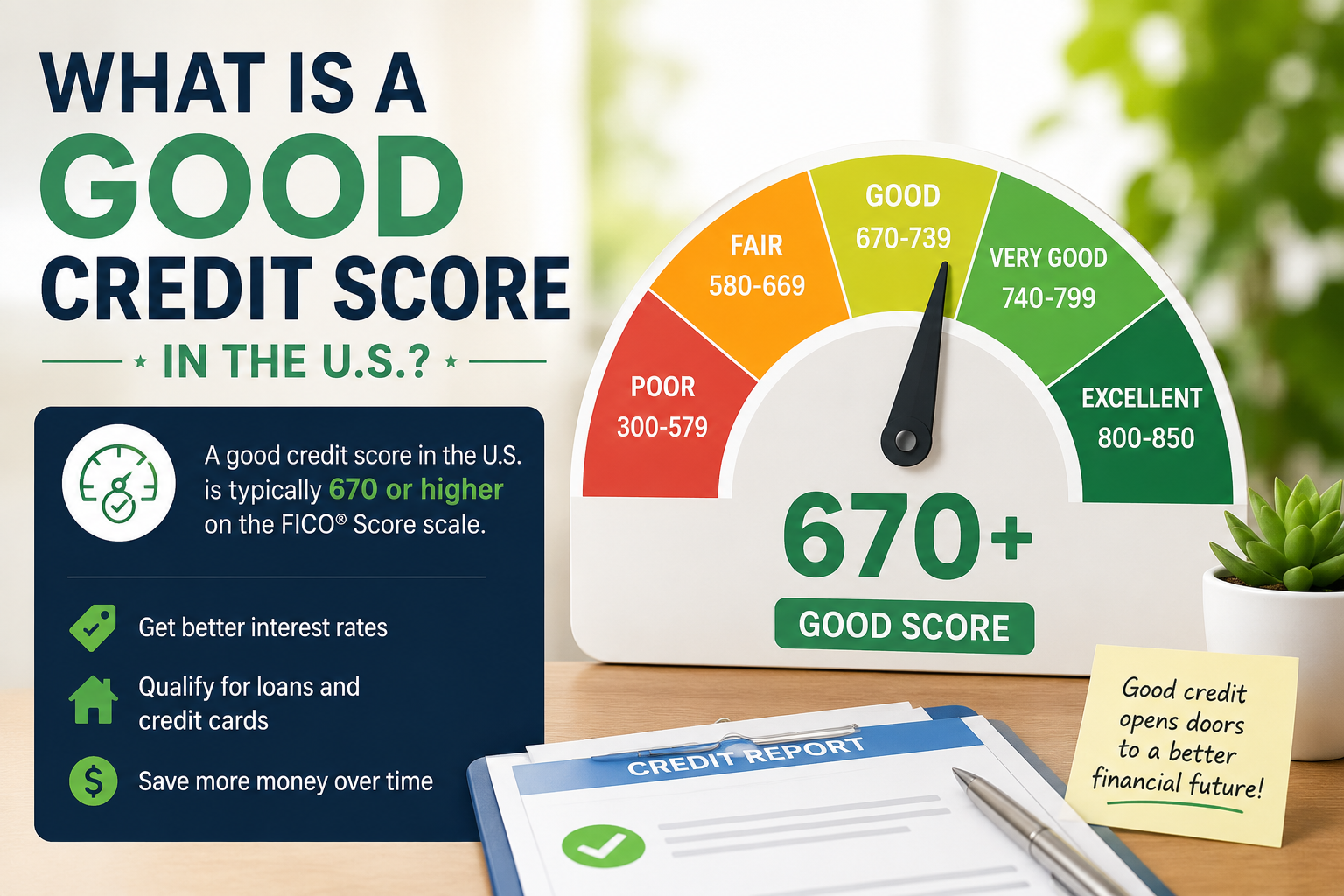
The answer depends on the credit scoring model being used. However, most of the credit scores you’ll encounter in the United States—including the most common FICO® Score and VantageScore® models—generally fall within a range of 300 to 850.
In simple terms, the higher your score, the more confidence a lender may have in your history of managing credit responsibly. A higher score doesn’t guarantee that you’ll be approved for a loan or receive the lowest interest rate, but it may improve your chances of qualifying for more favorable borrowing terms.
Think of your credit score as a snapshot of your credit history. It helps lenders quickly assess how you’ve handled borrowed money in the past, although it’s only one part of the overall lending decision.
General Credit Score Ranges
While different scoring models may use slightly different categories, the following ranges are widely recognized across the U.S. financial industry.
| Credit Score | General Rating | What It Typically Means |
|---|---|---|
| 300–579 | Poor | Borrowers in this range may have difficulty qualifying for credit and may be offered higher interest rates if approved. |
| 580–669 | Fair | Credit may still be available, but borrowing costs are often higher than for applicants with stronger credit profiles. |
| 670–739 | Good | Generally considered a good credit score by many lenders and may qualify borrowers for competitive financing, depending on other factors. |
| 740–799 | Very Good | Indicates a strong history of responsible credit management and may improve access to favorable loan and credit card offers. |
| 800–850 | Exceptional | Represents excellent credit management. Borrowers in this range may qualify for some of the most competitive financial products available, although approval is never guaranteed. |
A “Good” Credit Score Isn’t the Same for Every Lender
It’s important to understand that there isn’t one universal definition of a “good” credit score.
Different lenders set their own lending criteria based on factors such as:
- The type of loan you’re applying for.
- Your income and employment history.
- Your existing debt.
- Your down payment or collateral.
- Your overall credit profile.
For example, a mortgage lender may have different credit requirements than a credit card issuer or an auto finance company. Even two lenders using the same credit scoring model may make different lending decisions.
That’s why your credit score should be viewed as one piece of your overall financial picture—not the only factor that determines whether you’ll be approved.
Why Moving Up One Category Matters
Improving your credit score isn’t just about reaching an impressive number—it can open the door to better financial opportunities.
Moving from Fair to Good, or from Good to Very Good, may help you:
- Qualify for lower interest rates on loans.
- Increase your chances of credit approval.
- Access credit cards with better rewards and benefits.
- Reduce the overall cost of borrowing over time.
- Strengthen your financial flexibility when major expenses arise.
Even relatively small improvements in your credit score may make a meaningful difference, especially when borrowing larger amounts such as a mortgage or auto loan.
Key Takeaway: Most U.S. credit scores range from 300 to 850, with 670 or higher generally considered a good credit score by many lenders. However, there is no universal cutoff, and lenders consider your overall financial profile—not just your credit score—when making lending decisions.
FICO® Credit Score Ranges Explained
If you’ve spent any time researching credit scores, you’ve probably come across the term FICO® Score.
That’s because FICO is the most widely used credit scoring system in the United States. According to FICO, 90% of top lenders use FICO Scores when making lending decisions, although the specific version may vary depending on the lender and the type of loan. (myFICO)
Whether you’re applying for a mortgage, auto loan, personal loan, or credit card, there’s a good chance your lender will review one or more FICO Scores as part of the approval process.
What Is a FICO Score?
A FICO® Score is a three-digit number that helps lenders estimate how likely a borrower is to repay debt based on information in their credit reports.
Most base FICO Scores range from 300 to 850.
In general:
- Higher scores indicate lower credit risk.
- Lower scores indicate higher credit risk.
- A higher score may improve your chances of qualifying for credit and receiving more competitive interest rates, although approval is never guaranteed. (myFICO)
Official FICO Score Ranges
FICO groups credit scores into five broad categories that many lenders use as a starting point when evaluating borrowers.
| FICO® Score | Rating | What It Generally Means |
|---|---|---|
| 300–579 | Poor | Indicates significant credit risk. Borrowers may have difficulty qualifying for credit or may receive higher interest rates and stricter lending terms. |
| 580–669 | Fair | Below the U.S. average. Some lenders may approve applications, but financing is often more expensive. |
| 670–739 | Good | Considered a good credit score by many lenders. Borrowers in this range may qualify for competitive credit products, depending on their overall financial profile. |
| 740–799 | Very Good | Demonstrates a strong history of managing credit responsibly and may improve access to favorable loan terms. |
| 800–850 | Exceptional | Represents excellent credit management and may qualify borrowers for some of the most competitive lending offers available. (myFICO) |
What Does Each FICO Range Mean?
Poor (300–579)
Borrowers in this range may have experienced challenges such as missed payments, accounts in collections, or other negative credit events. While obtaining credit is still possible, lenders may require larger down payments, higher interest rates, or additional conditions.
Fair (580–669)
A fair credit score is often enough to qualify for certain loans and credit cards, but borrowers may not receive the best available rates. Improving your score into the next category can potentially reduce borrowing costs.
Good (670–739)
This is the range many consumers aim for. According to FICO, scores between 670 and 739 are generally considered “Good” and are near or above the average score of U.S. consumers. Many lenders view borrowers in this range as responsible credit users. (myFICO)
Very Good (740–799)
Borrowers with very good credit have typically demonstrated consistent on-time payments, responsible credit usage, and a well-established credit history. They may have access to more competitive loan and credit card offers.
Exceptional (800–850)
An exceptional credit score reflects outstanding credit management over time. While an 800+ score does not guarantee loan approval, it generally places borrowers among the strongest credit applicants and may help them qualify for the most favorable interest rates available. (myFICO)
Remember: Lenders Don’t Look at Your Score Alone
Your FICO Score is an important part of the lending process, but it isn’t the only factor lenders consider.
Depending on the type of credit you’re applying for, a lender may also review:
- Your income.
- Your employment history.
- Your debt-to-income ratio.
- Your existing monthly obligations.
- Your savings and assets.
- The size of your down payment.
- The amount you’re borrowing.
For example, two applicants with the same 720 FICO Score could receive different loan offers if one has significantly higher income or less existing debt than the other.
Different Versions of FICO Scores
Another point that surprises many consumers is that you don’t have just one FICO Score.
FICO has developed multiple scoring models over the years, including versions designed for specific industries such as auto lending and credit cards. As a result, your mortgage lender, auto lender, and credit card issuer may each use different FICO Score versions when evaluating your application. (myFICO)
This is one reason why the score you see from your bank or a personal finance app may not exactly match the score a lender uses.
Learn More from FICO
If you’d like to learn more about how FICO Scores work, the official educational resources from FICO are an excellent place to start:
Key Takeaway: A FICO® Score of 670 or higher is generally considered a good credit score. However, the strongest loan offers often go to borrowers with scores in the Very Good (740–799) or Exceptional (800–850) ranges, combined with solid income, manageable debt, and an overall healthy financial profile. (myFICO)
VantageScore® Credit Score Ranges Explained
Many consumers assume they have one universal credit score. In reality, several credit-scoring models may be used to evaluate the information in a credit report.
The two most widely recognized brands are FICO® and VantageScore®.
Although both models are designed to help lenders evaluate credit risk, they are separate scoring systems. They may weigh information differently, use different calculation methods, and produce different scores—even when they review information from the same credit bureau.
That means the score shown by a bank, credit card app, or free credit-monitoring service may not be the exact score a lender sees when you apply for credit.
The Consumer Financial Protection Bureau explains that consumers do not have only one credit score. A score can vary depending on the model, the credit-report data used, the type of lending product, and the date on which the score was calculated. (Consumer Financial Protection Bureau)
What Is VantageScore?
VantageScore is a credit-scoring system created through a joint effort by the three major U.S. credit-reporting companies:
- Equifax
- Experian
- TransUnion
Like FICO, VantageScore analyzes information in your credit report and produces a number intended to help lenders estimate your likelihood of repaying borrowed money.
The newer VantageScore 3.0 and 4.0 models use a range of 300 to 850, matching the numerical range used by most base FICO Scores. (VantageScore)
However, the meaning of each score category is not identical.
VantageScore Credit Score Ranges
VantageScore commonly groups scores into four broad categories:
| VantageScore | Credit Tier | What It Generally Means |
|---|---|---|
| 300–600 | Subprime | Applicants may find it harder to qualify for credit and may face higher rates or stricter terms. |
| 601–660 | Near Prime | Some credit options may be available, but borrowers may not qualify for the most competitive terms. |
| 661–780 | Prime | Generally viewed as a good credit range and may help borrowers qualify for more favorable products. |
| 781–850 | Superprime | Represents a strong credit profile and may improve access to highly competitive offers. |
Experian also describes 661 to 780 as a good VantageScore range, with scores from 781 to 850 falling into the highest category. (Experian)
These categories help describe general levels of credit risk, but they are not universal approval standards. Each lender can establish its own credit requirements.
FICO and VantageScore Ranges Compared
At first glance, FICO and VantageScore appear almost identical because their newer models both generally use a scale from 300 to 850.
The category boundaries, however, are different.
| General Rating | FICO® Score Range | VantageScore® Range |
|---|---|---|
| Lowest category | 300–579: Poor | 300–600: Subprime |
| Below good/prime | 580–669: Fair | 601–660: Near Prime |
| Good or prime | 670–739: Good | 661–780: Prime |
| Stronger range | 740–799: Very Good | Included within 661–780 Prime |
| Highest range | 800–850: Exceptional | 781–850: Superprime |
For example, a score of 665 would generally fall into the Fair FICO category but the Prime VantageScore category.
That does not necessarily mean one model views the person as responsible while the other does not. It means the two systems label and group their score ranges differently.
Why Your FICO and VantageScore May Be Different
Suppose your credit-monitoring app shows a VantageScore of 710, but a lender later tells you that your FICO Score is 692.
That does not automatically mean either score is wrong.
The difference may be caused by:
- The scoring model used
- The version of that scoring model
- The credit bureau supplying the data
- Differences among your three credit reports
- The date each score was calculated
- How the model evaluates balances, inquiries, account age, and other information
- Whether the lender uses an industry-specific score
For instance, a lender might review an auto-specific FICO Score, while your free monitoring service provides a general VantageScore. Both scores can be legitimate, but they were created for different purposes.
Older VantageScore Models Used a Different Scale
An important historical detail is that earlier VantageScore models did not always use the familiar 300-to-850 scale.
Older versions used a range of 501 to 990. Newer VantageScore models moved to the 300-to-850 range, making their numerical scale more familiar and easier to compare with FICO Scores.
This is why consumers may occasionally find older articles showing a different VantageScore range. For current educational content, the newer 300-to-850 scale is generally the most relevant.
Which Score Will a Lender Use?
There is no single answer.
A lender may use:
- A base FICO Score
- An industry-specific FICO Score
- A VantageScore
- A proprietary internal scoring model
- More than one score or credit report
The choice may depend on the lender, the type of loan, and the lender’s underwriting policies.
This is also why you should focus less on matching one exact number and more on building a healthy underlying credit profile.
Responsible habits—such as paying bills on time, keeping credit card balances manageable, and checking your credit reports for errors—can generally benefit your credit standing across multiple scoring models.
A Free Score Can Still Be Useful
A free VantageScore may not always match the score used by a particular lender, but it can still help you:
- Monitor the general direction of your credit
- Identify major changes
- Recognize possible reporting problems
- Understand which factors may be helping or hurting your score
- Build better credit habits over time
The CFPB notes that many consumers can obtain free scores through credit card companies, lenders, and nonprofit credit or housing counselors. You can learn more through the agency’s guide on where to obtain credit scores. (Consumer Financial Protection Bureau)
You can also explore VantageScore’s official consumer education resources for information about score factors and reason codes. (VantageScore)
Key Takeaway: Newer FICO and VantageScore models generally use the same 300-to-850 scale, but their category boundaries and calculation methods are not identical. A score considered “Fair” under one model may fall into a “Prime” category under another. Rather than worrying about one exact number, focus on the credit habits and report information that influence all major scoring models.
Is 700 a Good Credit Score?
One of the most common questions people ask is:
“Is my credit score good enough?”
The answer depends on what you’re trying to do.
For example, a 700 credit score may be enough to qualify for many loans and credit cards, but it doesn’t automatically guarantee the lowest interest rates. Lenders also consider your income, debt, employment, down payment, and overall financial profile.
Still, understanding where your score falls can help you know what opportunities may be available and what your next goal should be.
Below is a practical guide to some of the most commonly searched credit scores in the United States.
Is a 600 Credit Score Good?
Short answer: Not usually.
A 600 credit score is generally considered below the “good” range by most FICO scoring models.
You may still qualify for:
- Secured credit cards
- Some personal loans
- Certain auto loans
- Credit-builder loans
However, you may also experience:
- Higher interest rates
- Larger security deposits
- Lower credit limits
- More loan denials
Goal: Improve to 670+, where many lenders begin classifying borrowers as having good credit.
Is a 620 Credit Score Good?
A 620 credit score is an improvement over 600, but it’s still generally considered Fair under FICO’s scoring model.
At this level you may qualify for:
- FHA mortgages (if you meet other requirements)
- Some conventional auto loans
- Entry-level unsecured credit cards
- Personal loans
You may not yet receive the lender’s most competitive interest rates.
If you continue making on-time payments and reduce credit card balances, moving into the high 600s can significantly improve your borrowing options.
Is a 650 Credit Score Good?
A 650 credit score is approaching the “Good” category but is still generally considered Fair by FICO.
Many borrowers with a 650 score can qualify for:
- Auto financing
- Credit cards
- Personal loans
- Some mortgages
However, lenders may still charge higher interest rates than they would for borrowers with stronger credit.
Even increasing your score by 20 or 30 points could make a noticeable difference in borrowing costs.
Is a 680 Credit Score Good?
Yes—680 is generally considered a good starting point.
A 680 score falls within FICO’s Good range.
At this level you may qualify for:
- Competitive auto loans
- Many rewards credit cards
- Conventional mortgages (if you meet other requirements)
- Lower interest rates than borrowers with fair credit
Although this is a strong position, borrowers with scores above 740 may qualify for even better financing offers.
Is a 700 Credit Score Good?
Yes.
A 700 credit score is generally considered a Good credit score.
Many lenders view borrowers in this range as responsible credit users.
Possible benefits include:
- Better mortgage opportunities
- Lower auto loan interest rates
- Access to premium credit cards
- Higher credit limits
- Better approval odds
For many Americans, reaching 700 represents an important financial milestone.
Is a 720 Credit Score Good?
Absolutely.
A 720 credit score places you comfortably within the Good range and close to the Very Good category.
You may qualify for:
- Competitive mortgage rates
- Better refinancing offers
- Premium travel rewards cards
- Larger credit limits
- Lower borrowing costs
Many lenders consider applicants with scores around 720 to be relatively low-risk borrowers.
Is a 740 Credit Score Good?
Yes—740 is considered Very Good.
Crossing the 740 mark is significant because many lenders reserve some of their most competitive interest rates for borrowers at or above this level.
Benefits may include:
- Excellent mortgage rates
- Lower monthly loan payments
- Better balance transfer offers
- High-end rewards credit cards
- Increased approval odds
Although every lender has its own criteria, many borrowers target 740 because it often unlocks stronger financing opportunities.
Is a 760 Credit Score Good?
A 760 credit score is excellent.
Borrowers in this range often qualify for:
- Some of the lowest available mortgage rates
- Excellent auto financing offers
- Premium rewards cards
- Large credit limits
- Easier approval for many financial products
At this point, improving your score further may still be beneficial, but the financial differences between 760 and 800 are often smaller than the differences between 620 and 700.
Is an 800 Credit Score Good?
More than good—it’s Exceptional.
An 800 credit score places you among consumers with outstanding credit histories.
Potential advantages include:
- Access to some of the best interest rates available
- Premium travel and cashback credit cards
- High approval odds for many loans
- Better negotiating power with lenders
It’s important to remember that even an 800 score doesn’t guarantee approval. Lenders still evaluate your income, debt, employment, and other financial information.
Is an 850 Credit Score Good?
Yes.
An 850 credit score is the highest score available under most standard FICO and VantageScore models.
Achieving an 850 is uncommon and is not necessary to qualify for excellent lending terms.
Someone with a 780, 800, or 820 score may receive the same interest rate as someone with a perfect 850.
In other words, you don’t need a perfect score to enjoy excellent financial opportunities.
Credit Score Comparison
| Credit Score | General Rating | What You Can Typically Expect |
|---|---|---|
| 600 | Fair | Limited credit options and higher interest rates. |
| 620 | Fair | May qualify for some mortgages, auto loans, and credit cards. |
| 650 | Fair | Better approval odds, but borrowing may still be expensive. |
| 680 | Good | Competitive financing begins to become more accessible. |
| 700 | Good | Strong approval chances for many loans and credit cards. |
| 720 | Good | Better interest rates and access to premium financial products. |
| 740 | Very Good | May qualify for some of the most competitive lending offers. |
| 760 | Very Good | Excellent credit with access to premium borrowing opportunities. |
| 800 | Exceptional | Outstanding credit profile and highly competitive loan offers. |
| 850 | Exceptional | The highest standard score, though not usually necessary to receive the best available rates. |
Can You Get Approved With a Lower Score?
Yes.
There is no universal minimum credit score for every loan or credit card.
Some lenders specialize in borrowers with lower credit scores, while others focus on applicants with exceptional credit.
Your approval may also depend on:
- Your income
- Your debt-to-income ratio
- Your employment history
- Your down payment
- The type of loan
- Your overall credit history
This is why two people with the same 700 credit score may receive different loan offers.
Focus on Progress, Not Perfection
Many people believe they need an 800+ credit score before applying for a loan.
In reality, moving from 620 to 700 often has a much greater financial impact than moving from 800 to 850.
Each improvement in your credit score can help reduce borrowing costs and expand your financial options.
If you’re not yet where you want to be, focus on consistent habits:
- Pay every bill on time.
- Keep credit card balances low.
- Avoid applying for unnecessary credit.
- Review your credit reports regularly for errors.
- Give your credit history time to grow.
For more information about FICO Score ranges, visit myFICO’s Credit Education Center. The Consumer Financial Protection Bureau (CFPB) also offers free educational resources on understanding credit scores and reports.
Key Takeaway: A 700 credit score is generally considered good, but every improvement above that can increase your chances of qualifying for lower interest rates and better financial products. Rather than chasing a perfect 850, focus on building healthy credit habits that strengthen your overall financial profile.
What Can a Good Credit Score Help You Do?
Many people think a good credit score is only important when applying for a loan.
In reality, it can influence many parts of your financial life—from buying a home to getting approved for a rewards credit card, renting an apartment, or even setting up utility services.
While a credit score alone never guarantees approval, it can improve your chances of qualifying for better products, lower interest rates, and more favorable terms.
Here’s how good credit can make a difference.
1. Buy a Home With Better Mortgage Rates
For most Americans, purchasing a home is the largest financial commitment they’ll ever make.
Mortgage lenders use your credit score to estimate how risky it may be to lend you hundreds of thousands of dollars over 15 to 30 years.
Borrowers with stronger credit may qualify for:
- Lower mortgage interest rates
- Lower monthly mortgage payments
- More loan options
- Reduced borrowing costs over the life of the loan
- Easier refinancing opportunities in the future
Even a small reduction in your mortgage interest rate can translate into tens of thousands of dollars in savings over the life of a home loan.
For example:
- A $350,000 mortgage at 6.25% may cost significantly less over 30 years than the same loan at 7.25%.
The exact savings depend on loan amount, interest rate, and repayment period.
The Consumer Financial Protection Bureau offers a helpful guide to how credit affects mortgage borrowing:
2. Finance a Car for Less
Auto lenders also rely heavily on credit scores.
Two people purchasing identical vehicles can receive dramatically different financing offers simply because one has stronger credit.
Good credit may help you receive:
- Lower APRs
- Smaller monthly payments
- More lender choices
- Lower required down payments
- Higher approval odds
On a five- or six-year car loan, even a few percentage points can save thousands of dollars.
3. Qualify for Better Credit Cards
Many premium credit cards are designed for borrowers with good or excellent credit.
A stronger credit profile may provide access to cards offering:
- Cash-back rewards
- Airline miles
- Hotel points
- Travel insurance
- Purchase protection
- Extended warranties
- Sign-up bonuses
- Higher credit limits
People with lower credit scores often qualify only for secured cards or basic unsecured cards with fewer benefits and higher interest rates.
Learn more about choosing the right credit card from:
4. Lower Your Insurance Costs
Many people are surprised to learn that credit information may influence insurance pricing.
In most U.S. states, insurers may use a credit-based insurance score when pricing:
- Auto insurance
- Homeowners insurance
- Renters insurance
A stronger credit history may be associated with lower insurance premiums.
However, rules vary by state.
For example, California, Hawaii, Massachusetts, and Michigan generally restrict or prohibit the use of credit information in certain insurance underwriting decisions.
The National Association of Insurance Commissioners (NAIC) explains how credit-based insurance scores work and where they may be used.
5. Improve Your Chances of Getting a Business Loan
If you own—or plan to start—a small business, your personal credit may play an important role.
Many banks and lenders review the owner’s personal credit history when evaluating:
- Startup loans
- SBA-backed loans
- Business credit cards
- Equipment financing
- Business lines of credit
A stronger personal credit profile may improve your financing options, especially for newer businesses that have not yet established their own business credit.
Learn more from:
6. Borrow Money Through Personal Loans
Unexpected expenses happen.
Whether you’re paying medical bills, consolidating debt, or covering emergency repairs, a personal loan may provide flexibility.
Good credit can help you qualify for:
- Lower interest rates
- Larger loan amounts
- Longer repayment terms
- Lower monthly payments
- More lender choices
Borrowers with lower scores may still qualify, but often at significantly higher borrowing costs.
7. Rent an Apartment More Easily
Many landlords review an applicant’s credit history before approving a lease.
A strong credit profile may help you:
- Get approved faster
- Reduce the likelihood of needing a co-signer
- Avoid larger security deposits
- Demonstrate financial responsibility
Landlords typically consider more than just your score.
They may also review:
- Payment history
- Collections
- Evictions
- Outstanding debts
- Income
8. Set Up Utilities With Smaller Deposits
When opening new utility accounts, companies may review your credit history.
Examples include:
- Electricity
- Natural gas
- Water
- Internet
- Cable television
- Mobile phone services
Customers with stronger credit may avoid security deposits, while others may need to pay refundable deposits before service begins.
Policies vary by provider and state.
9. Help During Employment Background Checks
Many job seekers don’t realize that employers may review certain aspects of a credit report during the hiring process.
This does not mean employers see your credit score.
Instead, when allowed by law and with your written permission under the Fair Credit Reporting Act (FCRA), some employers may obtain a modified credit report for positions involving:
- Financial responsibilities
- Accounting
- Banking
- Government security clearances
- Executive management
Employment credit reports generally do not include your credit score.
Several states restrict or prohibit the use of credit reports for many employment decisions, so the rules depend on where you live and the type of job.
Learn more from the Federal Trade Commission:
10. Negotiate Better Financial Terms
A strong credit score doesn’t just improve approval odds—it can also strengthen your negotiating position.
Depending on the lender, borrowers with stronger credit may receive:
- Lower interest rates
- Reduced fees
- Better promotional financing
- Higher borrowing limits
- More flexible repayment options
When lenders view you as a lower-risk borrower, they may compete more aggressively for your business.
11. Save Money Across Your Financial Life
One of the biggest benefits of good credit isn’t access to borrowing—it’s the ability to pay less for borrowing.
Consider someone who:
- Buys a home
- Finances two vehicles
- Opens a rewards credit card
- Purchases homeowners insurance
- Takes out a personal loan
If that person consistently qualifies for lower interest rates and more favorable terms because of strong credit, the total savings over many years could amount to tens of thousands of dollars.
That’s money that could instead be used to:
- Build an emergency fund
- Invest for retirement
- Save for children’s education
- Pay off debt faster
- Grow long-term wealth
Good Credit Opens Doors—But It Isn’t Everything
While a strong credit score is valuable, it’s only one piece of your financial picture.
Lenders may also evaluate:
- Your income
- Employment stability
- Debt-to-income ratio
- Savings and assets
- Loan amount
- Down payment
- Existing financial obligations
For example, someone with a 760 credit score and overwhelming debt may still be declined for a loan, while another borrower with a 700 score, stable income, and manageable debt could be approved.
This is why building healthy financial habits matters just as much as increasing your score.
Quick Summary
| Financial Goal | How Good Credit Can Help |
|---|---|
| Buy a home | Better mortgage rates and lower monthly payments |
| Buy a car | Lower APRs and financing costs |
| Rewards credit cards | Access to premium cards and higher limits |
| Insurance | May qualify for lower premiums in many states |
| Business financing | Better access to loans and business credit |
| Personal loans | Lower interest rates and more lender choices |
| Renting | Improved approval odds and smaller deposits |
| Utilities | Potentially avoid security deposits |
| Employment | May help where credit checks are permitted by law |
| Overall finances | Lower borrowing costs and greater financial flexibility |
Key Takeaway: A good credit score isn’t just a number—it can influence many of the financial opportunities available to you throughout life. From qualifying for a mortgage with a lower interest rate to renting an apartment, obtaining a business loan, or reducing insurance costs in some states, strong credit can help you spend less and access better financial products. Combined with steady income, responsible debt management, and sound financial habits, good credit can become one of your most valuable long-term financial assets.
Why Two People With the Same Credit Score May Receive Different Loan Offers
One of the biggest misconceptions about credit scores is that the person with the higher score always gets the better loan.
That’s not always true.
Imagine two people each have a 720 credit score.
They both apply for a $350,000 mortgage on the same day.
You might expect them to receive identical interest rates and loan terms.
Instead, one borrower is approved at 5.95%, while the other receives 6.65%—or one may even be declined.
How is that possible?
Because your credit score is only one part of the lender’s decision.
Most lenders evaluate your entire financial picture before approving a loan or determining the interest rate you’ll receive.
The Consumer Financial Protection Bureau (CFPB) explains that lenders typically consider several factors beyond your credit score, including your income, debts, employment, and the size of the loan you’re requesting.
Learn more:
Let’s look at the factors that can make two borrowers with identical credit scores receive very different offers.
1. Your Income
Your credit score doesn’t tell a lender how much money you earn.
Someone earning $45,000 per year and someone earning $180,000 per year could both have a 720 credit score.
If both apply for a large mortgage, the higher-income borrower may be better positioned to comfortably afford the monthly payments.
Lenders generally want to know whether your income is sufficient to repay the loan—not just whether you’ve handled credit responsibly in the past.
They may review:
- Salary or wages
- Self-employment income
- Bonuses or commissions
- Retirement income
- Rental income
- Other verified sources of income
A strong, stable income can improve your overall loan application.
2. Your Debt-to-Income (DTI) Ratio
One of the most important factors lenders evaluate is your debt-to-income ratio (DTI).
Your DTI compares your monthly debt payments to your gross monthly income.
For example:
Borrower A
- Monthly income: $7,500
- Monthly debt: $900
- DTI: 12%
Borrower B
- Monthly income: $7,500
- Monthly debt: $3,500
- DTI: 47%
Even if both borrowers have a 720 credit score, Borrower A may be viewed as less financially stretched.
A lower DTI often improves your chances of qualifying for competitive loan terms.
The CFPB provides additional information about calculating and understanding debt-to-income ratios:
3. Your Down Payment
For mortgages and auto loans, the amount you put down matters.
Suppose two homebuyers each have a 740 credit score.
One buyer puts down:
20%
The other puts down:
3%
The borrower making the larger down payment is borrowing less money, reducing the lender’s financial risk.
That may improve:
- Interest rates
- Loan approval odds
- Private mortgage insurance (PMI) requirements
- Monthly payments
A larger down payment demonstrates financial preparedness and lowers the lender’s exposure if property values decline.
4. Your Employment History
Lenders also want to know whether your income is likely to continue.
Someone who has worked steadily for several years may appear less risky than someone who recently changed jobs multiple times or has irregular income.
That doesn’t mean changing jobs automatically hurts your application.
Instead, lenders often consider:
- Employment stability
- Length of time with your employer
- Occupation
- Income consistency
- Self-employment history
Stable employment can strengthen an application even when two borrowers have identical credit scores.
5. Your Existing Financial Obligations
Your credit score doesn’t reveal your complete monthly financial commitments.
For example, you might already be paying for:
- Student loans
- Child support
- Alimony
- Auto loans
- Multiple credit cards
- Personal loans
Even with an excellent credit score, substantial existing obligations may reduce the amount a lender is willing to approve.
Lenders want confidence that you can comfortably handle both your current obligations and the new loan.
6. Your Savings and Assets
Having savings won’t directly increase your credit score, but it can strengthen your loan application.
Lenders may view borrowers more favorably if they have:
- Emergency savings
- Retirement accounts
- Investment accounts
- Cash reserves
- Other valuable assets
These resources may demonstrate financial stability and provide reassurance that the borrower has funds available if unexpected expenses arise.
7. Your Relationship With the Bank or Credit Union
Some financial institutions offer benefits to existing customers.
If you’ve had a checking account, savings account, mortgage, or investment account with a bank for years, you may qualify for:
- Relationship discounts
- Reduced loan fees
- Faster approval processes
- Preferred customer rates
- Special promotions
These benefits vary by lender and should never be assumed, but they can sometimes make a meaningful difference.
8. The Amount You’re Borrowing
The size of your loan also matters.
A borrower requesting:
- $12,000 for a used vehicle
may be evaluated differently from someone requesting:
- $900,000 for a luxury home
Larger loans generally involve greater financial risk for lenders, leading to more detailed underwriting.
The type of loan also matters.
For example:
- Mortgage underwriting differs from credit card approvals.
- Auto loans have different risk models than personal loans.
- Business loans often involve additional financial documentation.
9. The Property or Vehicle You’re Buying
For secured loans, lenders also evaluate the asset itself.
Examples include:
Mortgages
- Property value
- Property condition
- Appraisal results
- Loan-to-value (LTV) ratio
Auto loans
- Vehicle age
- Vehicle value
- New vs. used
- Loan amount compared to vehicle value
Even with excellent credit, financing an older vehicle or an overvalued property may affect your loan terms.
10. The Lender’s Own Policies
Perhaps the most overlooked factor is this:
Every lender has different underwriting rules.
One bank may approve your application.
Another may decline it.
A third may approve you—but offer a different interest rate.
That’s because lenders have different:
- Risk tolerance
- Lending strategies
- Minimum credit requirements
- Income requirements
- Debt limits
- Promotional offers
This is why financial experts often recommend shopping around before accepting a loan offer.
The CFPB encourages consumers to compare mortgage offers from multiple lenders because rates, fees, and terms can vary significantly.
Real-Life Example
Consider these two borrowers:
| Borrower A | Borrower B | |
|---|---|---|
| Credit Score | 720 | 720 |
| Annual Income | $120,000 | $55,000 |
| Debt-to-Income Ratio | 18% | 43% |
| Down Payment | 20% | 5% |
| Savings | $45,000 | $2,000 |
| Employment | 8 years | 8 months |
| Existing Loans | Minimal | Multiple loans |
Although both borrowers have the same credit score, Borrower A presents a stronger overall financial profile. As a result, Borrower A may qualify for a lower interest rate or more favorable loan terms.
Your Credit Score Opens the Door—It Doesn’t Finish the Application
Think of your credit score as your financial résumé.
It gives lenders a quick summary of how you’ve managed credit in the past.
But before approving a loan, lenders usually want to understand your broader financial situation.
That’s why building wealth isn’t just about increasing your credit score.
It’s also about:
- Growing your income
- Reducing debt
- Saving consistently
- Maintaining stable employment
- Building emergency savings
- Borrowing responsibly
Together, these habits create a stronger financial profile than a credit score alone can show.
Key Takeaway: Two people with the exact same credit score can receive very different loan offers because lenders evaluate much more than a three-digit number. Your income, debt-to-income ratio, down payment, employment history, savings, existing obligations, relationship with the lender, loan amount, and the lender’s own underwriting policies all influence the final decision. A strong credit score gets your foot in the door, but your overall financial health often determines the terms of the offer you receive.
How to Reach a Good Credit Score: A Step-by-Step Action Plan
Building a good credit score doesn’t happen overnight.
There’s no secret formula, no shortcut, and no legitimate company can guarantee that your score will jump by 100 points in a month.
Instead, good credit is built through consistent financial habits over time.
The encouraging news is that most of the factors affecting your credit score are within your control. By making smart decisions consistently, you can gradually strengthen your credit profile and improve your financial opportunities.
Whether you’re starting from scratch or trying to move from Fair to Good, here’s a practical action plan.
Step 1: Pay Every Bill on Time
If you only remember one thing from this guide, remember this:
Always pay your bills on time.
Payment history is the single most influential factor in your FICO® Score. Even one late payment can remain on your credit report for up to seven years, although its impact generally decreases over time as you continue making on-time payments.
That includes:
- Credit cards
- Auto loans
- Mortgages
- Student loans
- Personal loans
- Some other reported credit accounts
A long history of on-time payments demonstrates to lenders that you’re a reliable borrower.
Tips to Never Miss a Payment
- Set up automatic payments for at least the minimum amount due.
- Create calendar reminders a few days before each due date.
- Use your bank’s bill-pay service.
- Keep a small emergency fund to avoid missing payments during unexpected financial setbacks.
The official FICO education center explains why payment history has such a significant impact on credit scores:
Step 2: Keep Your Credit Utilization Low
One of the fastest ways to improve your credit score is by lowering your credit utilization ratio.
Credit utilization measures how much of your available revolving credit you’re currently using.
For example:
| Credit Card Limit | Current Balance | Utilization |
|---|---|---|
| $5,000 | $500 | 10% |
| $5,000 | $2,500 | 50% |
| $5,000 | $4,500 | 90% |
Even if you pay your bills on time every month, consistently carrying high balances may negatively affect your credit score.
Many financial experts recommend keeping utilization below 30%, while borrowers with the highest credit scores often maintain utilization in the single digits.
Ways to reduce utilization include:
- Paying balances before the statement closing date.
- Making multiple payments throughout the month.
- Paying down existing debt.
- Avoiding large purchases right before your statement closes.
- Requesting a higher credit limit (if appropriate), without increasing your spending.
Learn more from:
Step 3: Avoid Applying for Too Much Credit at Once
Every time you apply for new credit, the lender may perform a hard inquiry on your credit report.
A single inquiry usually has only a small effect, but submitting multiple applications in a short period may suggest to lenders that you’re experiencing financial stress.
This doesn’t mean you should never apply for credit.
Instead:
- Apply only when you genuinely need new credit.
- Avoid submitting several credit card applications on the same day.
- Compare lenders carefully before applying.
- Be cautious of “pre-approved” offers that still require a hard inquiry.
FICO notes that rate shopping for certain loans—such as mortgages, auto loans, and student loans—within a limited period is generally treated as a single inquiry for scoring purposes.
Learn more:
Step 4: Review Your Credit Reports Regularly
Your credit score is only as accurate as the information in your credit reports.
Mistakes happen.
You might discover:
- Accounts that aren’t yours.
- Incorrect late payments.
- Duplicate debts.
- Incorrect balances.
- Identity theft.
- Fraudulent accounts.
Finding and correcting errors can improve the accuracy of your credit profile.
Federal law allows consumers to obtain free credit reports from the three nationwide credit bureaus through the official government-authorized website:
The CFPB also provides guidance on reviewing reports and disputing inaccuracies:
Step 5: Be Patient
Improving your credit score takes time.
There is no legal way to erase accurate negative information from your credit report overnight.
If you’ve experienced financial setbacks, the best strategy is to establish a consistent pattern of responsible credit management.
Over time:
- On-time payments accumulate.
- Credit history becomes longer.
- High balances decrease.
- Older negative events have less influence.
- Your overall credit profile becomes stronger.
Think of building credit like growing a tree.
You can’t force it to mature in a week—but with consistent care, it grows stronger every year.
Step 6: Keep Older Credit Accounts Open
The length of your credit history is another factor considered by many credit scoring models.
Closing an older credit card isn’t always the best decision.
If the account has no annual fee and you’re using it responsibly, keeping it open may help by:
- Increasing your available credit.
- Lowering your overall utilization ratio.
- Maintaining a longer average age of accounts.
However, if an account has expensive annual fees or no longer fits your financial goals, closing it may still make sense. Consider the overall costs and benefits before making a decision.
Step 7: Build a Healthy Mix of Credit
Over time, responsibly managing different types of credit may strengthen your overall credit profile.
Examples include:
- Credit cards (revolving credit)
- Auto loans
- Student loans
- Mortgages
- Personal loans
This doesn’t mean you should borrow money simply to improve your credit score.
Only take on debt when it serves a genuine financial purpose and fits comfortably within your budget.
Step 8: Limit New Debt
Improving your credit score becomes more difficult if you’re continually adding new debt.
Before financing a purchase, ask yourself:
- Do I truly need this?
- Can I comfortably afford the monthly payments?
- Will this improve my financial situation?
- Could I save and pay cash instead?
Borrowing responsibly is just as important as making payments on time.
Step 9: Monitor Your Progress
Your credit score isn’t static.
It changes as new information is added to your credit reports.
Reviewing your score periodically can help you:
- Track improvements.
- Identify unexpected changes.
- Spot possible fraud.
- Stay motivated.
Many banks, credit card issuers, and financial institutions now provide free credit score monitoring to their customers.
Remember that the score you see may differ from the score a lender uses because different scoring models exist, but regular monitoring can still help you follow overall trends.
Common Mistakes That Can Hurt Your Credit
Even financially responsible people sometimes make avoidable mistakes.
Watch out for these common pitfalls:
- Missing payment due dates.
- Maxing out credit cards.
- Applying for multiple credit cards within a short period.
- Ignoring errors on your credit reports.
- Closing old accounts without understanding the impact.
- Co-signing loans without fully understanding the risk.
- Taking on more debt than you can comfortably repay.
Avoiding these mistakes can be just as important as adopting positive habits.
Your 12-Month Credit Improvement Checklist
If your goal is to reach a Good credit score, use this checklist as a guide:
✅ Pay every bill on time.
✅ Keep credit card utilization below 30% (and ideally much lower).
✅ Review your credit reports for errors at least once a year.
✅ Limit unnecessary credit applications.
✅ Keep older accounts open when appropriate.
✅ Pay down existing debt consistently.
✅ Build an emergency fund to reduce the risk of missed payments.
✅ Monitor your credit regularly.
✅ Be patient—lasting improvement takes time.
How Long Does It Take to Reach a Good Credit Score?
There isn’t a single timeline because every credit history is different.
For example:
- Someone with a short credit history but no missed payments may reach a good score relatively quickly.
- Someone recovering from collections, defaults, or bankruptcies may need several years of consistent positive credit behavior.
The important point is that every positive action moves you in the right direction.
Small improvements made consistently often lead to meaningful long-term results.
Final Thoughts
A good credit score isn’t built through luck or expensive credit repair programs.
It’s built through everyday financial decisions.
Pay your bills on time.
Keep your balances low.
Borrow responsibly.
Review your credit reports regularly.
And give your credit history time to grow.
These habits won’t just improve a three-digit number—they can help you qualify for better financial opportunities throughout your life.
Additional Trusted Resources
- myFICO Credit Education Center
- Consumer Financial Protection Bureau — Credit Reports & Scores
- AnnualCreditReport.com (Official Free Credit Reports)
Key Takeaway: Reaching a good credit score is a marathon, not a sprint. Focus on paying every bill on time, keeping credit card balances low, limiting unnecessary applications for new credit, reviewing your credit reports for accuracy, and practicing patience. Over time, these consistent habits can strengthen your credit profile and help you qualify for better rates, lower borrowing costs, and greater financial flexibility.
Part 9 — Mistakes That Keep Credit Scores Low
Improving your credit score is not only about doing the right things. It is also about avoiding mistakes that repeatedly pull your score in the wrong direction.
Some credit mistakes are obvious, such as failing to repay a loan. Others are less noticeable. You might pay every bill eventually but continue carrying nearly maxed-out credit cards. You might close an old account believing it will improve your score. You might co-sign for someone without realizing that their missed payment can become your credit problem too.
A single mistake may not destroy an otherwise healthy credit profile. However, repeated late payments, high balances, collections, unnecessary applications, and unresolved fraud can make it difficult to move from a fair score to a good one.
Here are the most common mistakes that keep credit scores low—and what to do instead.
1. Maxing Out Credit Cards
A credit card limit is not a spending target.
If your card has a $5,000 limit, using $4,900 of it may signal financial pressure—even when you make the minimum payment on time.
Credit-scoring models consider your credit utilization ratio, which compares your reported credit card balances with your available revolving credit.
Here is a simple example:
| Credit limit | Reported balance | Utilization |
|---|---|---|
| $5,000 | $500 | 10% |
| $5,000 | $1,500 | 30% |
| $5,000 | $3,500 | 70% |
| $5,000 | $4,900 | 98% |
The higher your utilization becomes, the more it may weigh on your credit score.
This can happen at two levels:
- Overall utilization: The total balances across all cards compared with all available limits.
- Individual-card utilization: The balance on one card compared with that card’s limit.
For example, suppose you have three cards with a combined limit of $15,000 and total balances of only $3,000. Your overall utilization is 20%, which may appear manageable. However, if one $3,000 card is completely maxed out while the others have no balance, the high utilization on that individual card may still be a concern.
The Consumer Financial Protection Bureau notes that credit-scoring companies consider how much credit you are using compared with how much is available. Paying down card balances can therefore help strengthen your profile. (Consumer Financial Protection Bureau)
What to Do Instead
Try to keep balances well below their limits.
Useful strategies include:
- Pay more than the minimum.
- Pay balances down before the statement closes.
- Make more than one payment during the month.
- Spread necessary spending across cards rather than maxing out one account.
- Stop adding new purchases while paying down a large balance.
- Avoid increasing spending after receiving a higher limit.
A frequently mentioned guideline is to remain below 30% utilization, but 30% is not a magical cutoff. Lower reported utilization is generally better, provided you continue using credit responsibly and pay balances as agreed.
Most importantly, do not carry a balance and pay interest simply because you believe it will help your score. You generally do not need to carry debt from month to month to build credit.
2. Making Late Payments
Payment history is one of the most important parts of a credit score.
A late payment may begin with something simple:
- You forgot the due date.
- Your automatic payment failed.
- You changed bank accounts.
- You assumed a payment had already processed.
- You could only afford part of the amount.
- A bill was sent to an old address.
Even when the reason is understandable, the account may eventually be reported as delinquent if it remains unpaid.
Negative payment-history information can generally remain on a credit report for up to seven years. Its effect may weaken over time, especially as you build newer positive history, but ignoring it does not make it disappear quickly. (Consumer Financial Protection Bureau)
A Few Days Late Is Different From a Reported Late Payment
Being one day late may result in a fee or loss of a promotional rate, depending on the account agreement. It does not necessarily mean the lender has already reported a late payment to the credit bureaus.
However, that is not a reason to delay.
Contact the lender immediately, make the payment as soon as possible, and confirm the account’s status. The longer an account remains unpaid, the more serious the consequences may become.
What to Do Instead
- Set automatic payment for at least the minimum due.
- Keep enough money in the linked account.
- Add calendar reminders several days before the due date.
- Review accounts after autopay runs to confirm the payment succeeded.
- Contact the lender before the due date when you expect difficulty paying.
- Bring past-due accounts current as soon as possible.
The CFPB recommends getting current and staying current after missed payments, because repayment history is central to building a strong score. (Consumer Financial Protection Bureau)
3. Paying Only the Minimum While Continuing to Spend
Making the minimum payment protects the account from becoming immediately past due, but it may do little to reduce a large balance.
Suppose your card balance is $4,800 and the minimum payment is $120. If you pay $120 but add another $300 in purchases, your balance may continue rising once interest is included.
This creates several problems:
- Utilization remains high.
- Interest charges accumulate.
- The repayment period becomes longer.
- There is less room for emergencies.
- One unexpected expense can push the card to its limit.
Paying on time is important, but paying on time while remaining heavily indebted may not be enough to produce the improvement you expect.
What to Do Instead
Create a repayment plan that reduces the principal balance every month.
You could:
- Stop using the card temporarily.
- Pay a fixed amount above the minimum.
- Direct extra income toward the highest-interest balance.
- Use the debt-snowball or debt-avalanche method.
- Ask the issuer whether a hardship program is available if payments are becoming unmanageable.
Do not take a new loan merely to move debt around unless the new arrangement genuinely reduces costs and you have a plan to avoid rebuilding the card balances.
4. Ignoring Collection Accounts
When an unpaid account is transferred or sold to a collection agency, avoiding calls and letters does not solve the problem.
Collection accounts may relate to:
- Credit cards
- Personal loans
- Utility bills
- Phone or internet accounts
- Apartment charges
- Medical bills
- Other unpaid obligations
A collection entry can generally remain on a credit report for up to seven years, subject to applicable reporting rules. Medical collections may be treated differently from some other debts, and industry reporting policies have changed over time, so you should review the current information appearing on your reports rather than assuming every collection will be handled identically. (Consumer Financial Protection Bureau)
Never Pay a Collection Without First Checking It
Before paying, confirm:
- The debt belongs to you.
- The amount is correct.
- The collector has the right to collect it.
- The account is not duplicated.
- The debt is not the result of identity theft.
- The dates and original creditor information are accurate.
Request information in writing and keep records of every conversation, letter, payment, and agreement.
Paying a collection does not guarantee that it will immediately disappear from your credit reports or that your score will increase by a specific number of points. Different scoring models may treat paid collections differently.
What to Do Instead
- Review all three credit reports.
- Dispute collection information that is inaccurate.
- Ask the collector to validate the debt.
- Get any settlement agreement in writing before paying.
- Request written confirmation after the account is resolved.
- Check your reports again to confirm the updated status.
Accurate negative information generally cannot be removed simply because it is inconvenient, but inaccurate or duplicated information can be disputed. (Consumer Financial Protection Bureau)
5. Applying for Credit Everywhere
Applying to several lenders may feel like a good way to increase your chances of approval.
Instead, it can create several new hard inquiries and lead to multiple new accounts within a short period.
Examples include applying for:
- Several store cards at checkout
- Multiple unsecured credit cards
- Personal loans from numerous lenders
- Financing every time a retailer offers a discount
- Credit products you do not actually need
One inquiry usually has a limited effect. However, numerous applications in a short period may indicate that you are urgently seeking debt.
New accounts may also reduce the average age of your credit history.
Prequalification Is Not Always the Same as Applying
Some lenders allow you to check likely eligibility using a soft inquiry, which generally does not affect your credit score. A full application may require a hard inquiry.
Before proceeding, ask:
- Is this only a prequalification?
- Will checking the offer affect my credit?
- At what point will a hard inquiry occur?
- Is the advertised rate guaranteed or only the lowest possible rate?
Rate Shopping Is Different
Credit-scoring models may group multiple inquiries for certain types of loans—such as auto loans, mortgages, and student loans—when they occur within a designated shopping period.
That protection should not be confused with applying for many unrelated credit cards. Credit card applications are generally considered separately.
What to Do Instead
- Research eligibility before applying.
- Use prequalification tools when available.
- Apply only for products that fit your needs.
- Space out unrelated applications.
- Compare fees, rates, and terms before authorizing a hard inquiry.
- Avoid applying merely for a small checkout discount.
6. Closing Your Oldest Credit Card Without Thinking It Through
Closing an old card may feel like responsible financial housekeeping.
However, it can affect your profile in two important ways:
- It reduces your total available credit.
- It may influence the age and composition of your credit history over time.
Suppose you have the following cards:
| Card | Limit | Balance |
|---|---|---|
| Old card | $8,000 | $0 |
| New card | $2,000 | $1,000 |
| Before closing | $10,000 | $1,000 |
Your overall utilization is 10%.
If you close the $8,000 card, your available credit drops to $2,000 while the balance remains $1,000. Your utilization becomes 50%.
The CFPB warns consumers not to assume that closing a credit card will improve their scores, partly because closing the account can affect available credit and utilization. (Consumer Financial Protection Bureau)
When Closing a Card May Still Make Sense
Keeping every account open is not always the right choice.
Closing may be reasonable when:
- The card has an expensive annual fee.
- The account encourages overspending.
- The terms are poor.
- You are separating finances after a relationship ends.
- The issuer will not convert it to a no-fee product.
- Fraud or account-management concerns make closure appropriate.
What to Do Before Closing
- Pay down balances on other cards.
- Ask whether the card can be changed to a no-annual-fee version.
- Redeem rewards.
- Move recurring charges to another payment method.
- Consider how the closure will affect utilization.
- Obtain confirmation that the account was closed at your request.
Do not keep a costly or harmful account solely for a few possible credit-score points. Your broader financial well-being matters more than preserving every account forever.
7. Co-Signing Without Understanding the Risk
Co-signing is not simply providing a character reference.
When you co-sign, you agree to become legally responsible for the debt if the primary borrower does not pay. The loan may appear on your credit reports, affect your debt obligations, and influence your ability to qualify for credit of your own.
The CFPB states that a co-signer is legally obligated to repay a loan when the primary borrower cannot. (Consumer Financial Protection Bureau)
Risks include:
- Missed payments damaging both people’s credit histories
- The balance affecting your debt-to-income ratio
- Collection activity being directed toward you
- Difficulty qualifying for your own mortgage or loan
- Damage to personal relationships
- Legal action if the debt remains unpaid
Even when the borrower promises to pay, circumstances can change because of job loss, illness, poor budgeting, or other financial problems.
Questions to Ask Before Co-Signing
- Could I afford every payment myself?
- Can I repay the entire balance if necessary?
- Will I receive statements or payment alerts?
- How will this affect my own borrowing plans?
- Is co-signer release available?
- Under what conditions can I be removed?
- Is there another way to help without accepting the debt?
For private student loans, both the borrower and co-signer can be affected by missed payments, and release from the obligation may not be simple. (Consumer Financial Protection Bureau)
What to Do If You Have Already Co-Signed
- Request online access or monthly statements.
- Set alerts for payment activity.
- Confirm each payment before the due date.
- Keep the lender’s contact information.
- Ask about co-signer release requirements.
- Prepare to make the payment yourself if the borrower misses it.
Co-sign only when you are willing and financially able to treat the debt as your own.
8. Missing Student Loan Payments
Student loans do not disappear because you stop opening emails from the servicer.
A missed payment can cause the account to become past due. Continued nonpayment may result in delinquency being reported to the nationwide credit bureaus and may eventually lead to default, depending on the loan type and applicable rules.
Federal Student Aid states that federal student loan delinquency may be reported to the national credit bureaus after the account reaches 90 days past due. (CRi)
Ignoring the account may lead to:
- Damage to your credit history
- Added interest or charges
- Collection activity
- Loss of access to certain repayment benefits
- Difficulty qualifying for future credit
- More complicated resolution later
What to Do When You Cannot Afford the Payment
Contact your loan servicer before missing payments.
Depending on the loan and your circumstances, possible options may include:
- Changing repayment plans
- Income-driven repayment for eligible federal loans
- Deferment
- Forbearance
- Loan rehabilitation or consolidation after default, where applicable
- A temporary hardship arrangement for some private loans
Not every option is appropriate for everyone. Some may cause interest to continue accumulating. Review the terms carefully rather than simply choosing the option that produces the lowest immediate payment.
Use your official Federal Student Aid account to identify federal loans and servicers. Be cautious of companies charging large upfront fees for help that may be available directly through official channels.
9. Ignoring Fraud or Accounts You Do Not Recognize
An unfamiliar account on your credit report is not something to check again next year.
It may be:
- A reporting mistake
- A legitimate account listed under an unfamiliar company name
- A duplicate account
- An account opened through identity theft
- Unauthorized activity on an existing account
Fraudulent accounts can create balances, missed payments, collections, and inquiries that do not belong to you. The longer they remain unresolved, the more complicated the damage may become.
Warning Signs of Possible Identity Theft
- Accounts you never opened
- Inquiries from companies you do not recognize
- Addresses that have never belonged to you
- Bills for unfamiliar products
- Unexpected debt-collection notices
- Changes to account contact information
- Credit applications being denied unexpectedly
What to Do Immediately
- Contact the company’s fraud department.
- Explain which account or charges are unauthorized.
- Change passwords on affected financial accounts.
- Review all three credit reports.
- Place a fraud alert or credit freeze when appropriate.
- Report identity theft through the FTC’s official recovery service.
- Dispute fraudulent information with the credit bureaus.
- Keep copies of all supporting documents.
IdentityTheft.gov provides a step-by-step recovery plan and instructions for contacting businesses and credit bureaus. (IdentityTheft.gov)
A fraud alert asks businesses to take extra steps to verify your identity. A credit freeze restricts access to your credit file and can make it harder for someone to open new accounts in your name. These tools serve different purposes, so choose based on your situation.
10. Never Reviewing Your Credit Reports
You cannot fix a problem you do not know exists.
Some people monitor a free credit score but never review the reports behind that score. A score shows a numerical result; a credit report shows the accounts and information used to help calculate it.
Reports may contain:
- Incorrect balances
- Payments marked late by mistake
- Accounts that are not yours
- Duplicate collections
- Outdated personal details
- Closed accounts listed incorrectly
- Fraudulent inquiries or accounts
Checking your reports does not damage your credit score.
What to Do Instead
Obtain reports from all three nationwide credit bureaus through AnnualCreditReport.com, the official federally authorized source.
Review each report separately because information may differ among Equifax, Experian, and TransUnion.
When you find a mistake, the CFPB recommends contacting both the credit-reporting company and the business that supplied the incorrect information. (Consumer Financial Protection Bureau)
11. Disputing Accurate Information in Hopes It Will Disappear
The credit-dispute process exists to correct inaccurate or incomplete reporting. It is not intended to erase debts you legitimately owe.
Some credit-repair companies encourage consumers to dispute every negative account, hoping that a creditor will fail to respond and the information will disappear.
This can create false expectations and waste time.
Accurate negative information generally cannot be removed simply because it lowers your score. Most negative account information may remain for up to seven years, while certain records may follow different timelines. (Consumer Financial Protection Bureau)
What to Do Instead
Dispute information when:
- The account is not yours.
- The balance is incorrect.
- A payment was wrongly marked late.
- The same debt appears more than once.
- The account status is inaccurate.
- Identity theft created the account.
- Information is being reported beyond the permitted period.
For accurate negative information, focus on resolving the account and building newer positive history.
12. Believing You Must Carry a Balance to Build Credit
You do not need to pay interest to prove that you can manage credit.
Using a card and paying the statement balance in full can still create payment history and account activity. Carrying debt from one billing cycle to the next may simply generate interest charges.
What to Do Instead
- Use the card for manageable purchases.
- Allow the issuer to generate a statement.
- Pay the statement balance by the due date.
- Avoid spending more than you could repay from available cash.
- Monitor the reported balance when utilization is a concern.
Paying your balance in full can support healthy credit management while helping you avoid unnecessary interest. (Consumer Financial Protection Bureau)
13. Using Buy Now, Pay Later Without Tracking Every Payment
Splitting purchases into smaller installments may feel easier than using a traditional loan or credit card.
The risk is that several small plans can overlap:
- $40 for clothing
- $65 for electronics
- $30 for household items
- $90 for travel
- $55 for another online order
Individually, each payment may appear manageable. Together, they can strain your budget and increase the risk of missed payments, overdrafts, or collection activity.
Not every provider reports account activity in the same way, and reporting practices may change. Do not assume an installment plan cannot affect your credit simply because it was advertised as convenient.
What to Do Instead
Track every plan in one place and calculate the total amount due each month before accepting another purchase.
14. Opening Joint Accounts Without Clear Rules
Joint borrowing means both account holders may be responsible for the debt.
A joint account can affect both people’s credit histories, regardless of who made the purchases or who originally promised to pay.
Problems may arise when:
- One person spends without telling the other.
- Payments are missed after a breakup.
- The account is used beyond the agreed budget.
- One person assumes the other has paid.
- An authorized user is confused with a joint borrower.
Before sharing credit, confirm each person’s legal responsibility and establish clear rules for spending, payments, statements, and account closure.
15. Becoming an Authorized User on a Poorly Managed Account
Being added as an authorized user to a well-managed, long-standing credit card may sometimes help a person’s credit profile if the issuer reports authorized-user activity.
However, it can work in the opposite direction when the primary cardholder:
- Carries a very high balance
- Misses payments
- Maxes out the account
- Fails to communicate
- Loses control of the card
Before being added, ask about the card’s age, payment history, balance, limit, and how the issuer reports authorized users.
Do not ask to become an authorized user merely to obtain permission to spend. The purpose should be responsible credit-building, with clear boundaries established by the primary account holder.
16. Assuming Higher Income Automatically Creates a Higher Score
Your salary is not generally included in the calculation of standard consumer credit scores.
A person earning $200,000 can have poor credit after repeatedly missing payments. Someone earning $40,000 can have strong credit by borrowing carefully and consistently paying on time.
Income still matters when lenders evaluate whether you can afford a new loan, but it should not be confused with the score itself.
This distinction explains why:
- A high earner may have a low score.
- A moderate-income borrower may have an excellent score.
- Two people with the same score may receive different loan offers.
Focus on how you manage credit—not on assuming income will compensate for poor payment behavior.
17. Expecting Results Immediately
Credit improvement is usually gradual.
Paying off a card may help after the new balance is reported, but other changes can take longer. Older missed payments and collections do not instantly lose all influence because you made one positive payment.
This leads some people to become discouraged and abandon their plan.
What to Do Instead
Measure progress over several months rather than checking your score every day.
Track improvements such as:
- Every account is current.
- Utilization is falling.
- No new unnecessary inquiries have been added.
- Incorrect information has been disputed.
- Collection accounts are being addressed.
- Emergency savings are growing.
- On-time payment history is becoming longer.
A strong credit profile is built through repetition, not one perfect month.
Quick Summary: Credit Mistakes and Better Alternatives
| Mistake | Why It Can Keep Your Score Low | Better Approach |
|---|---|---|
| Maxing out cards | Produces high utilization | Keep reported balances low |
| Paying late | Damages payment history | Use autopay and reminders |
| Paying only minimums | Keeps balances and utilization high | Pay enough to reduce principal |
| Ignoring collections | Leaves unresolved negative accounts | Verify, dispute, or resolve them |
| Applying everywhere | Adds inquiries and new accounts | Research and apply selectively |
| Closing an old card | May reduce available credit | Review utilization and fees first |
| Co-signing casually | Makes you legally responsible | Co-sign only if you can repay it |
| Missing student loans | May lead to reported delinquency | Contact the servicer early |
| Ignoring fraud | Allows false accounts to remain | Report, freeze, and dispute quickly |
| Never checking reports | Errors remain undiscovered | Review all three reports |
| Carrying interest unnecessarily | Costs money without being required | Pay statement balances in full |
| Expecting instant results | Encourages poor decisions | Build positive history patiently |
A Recovery Plan After Credit Mistakes
If you recognize several of these mistakes in your own history, do not panic.
Use this order of priority:
First: Stop New Damage
Bring accounts current, stop adding unnecessary debt, and avoid new applications.
Second: Protect Essential Payments
Prioritize housing, utilities, transportation, insurance, and required debt payments within a realistic budget.
Third: Review Your Reports
Identify late payments, collections, incorrect balances, inquiries, and unfamiliar accounts.
Fourth: Address Fraud and Errors
Dispute inaccurate information and report identity theft immediately.
Fifth: Reduce Revolving Balances
Focus on cards closest to their limits while continuing to make every required payment.
Sixth: Resolve Delinquent Accounts
Contact lenders, servicers, or legitimate collectors to understand available options.
Seventh: Build New Positive History
Pay every account on time and keep card balances manageable.
Eighth: Give the Process Time
Accurate negative information may remain for years, but its presence does not prevent you from adding newer positive history.
Trusted Resources
- Consumer Financial Protection Bureau — Credit Reports and Scores
- AnnualCreditReport.com — Official Credit Reports
- Federal Student Aid — Delinquency and Default
- IdentityTheft.gov — Identity-Theft Recovery
- CFPB — How to Rebuild Your Credit
Key Takeaway: Low credit scores are often kept low by repeated patterns rather than one isolated mistake. Maxed-out cards, late payments, unresolved collections, unnecessary applications, careless co-signing, missed student loans, and ignored fraud can continue affecting your profile until you take action. Stop new damage first, correct inaccurate information, reduce balances, bring accounts current, and build a longer record of responsible payments.
How Long Does It Take to Build a Good Credit Score?
One of the first questions people ask after deciding to improve their credit is:
“How long will it take?”
Unfortunately, there isn’t a single answer.
Building a good credit score is similar to improving your physical fitness. Two people can follow the same plan but reach their goals at different times because they started from different places.
Someone with no credit history may build a good score relatively quickly, while someone recovering from multiple late payments, collections, or a bankruptcy may need several years of consistent financial habits.
The important thing to remember is this:
Credit scores don’t improve on a fixed schedule. They improve as positive information gradually outweighs older negative information.
Below are several common situations and realistic expectations.
Scenario 1: You Have No Credit History
Typical Timeframe: About 3–6 Months to Generate a Credit Score
If you’ve never had a credit card, loan, or other reported credit account, you may not have enough information for many scoring models to calculate a score.
This is common for:
- Young adults
- College students
- Recent immigrants
- People who have always paid cash
- Individuals who have never borrowed money
Fortunately, building credit from scratch is often simpler than rebuilding damaged credit.
A Typical Path
Month 1
- Open your first credit account.
- Use it for small purchases.
- Pay every bill on time.
Months 2–5
- Continue using the account responsibly.
- Keep balances low.
- Avoid missing payments.
Around Month 6
Many scoring models may have enough information to generate your first credit score, although the exact timing depends on the scoring model and the amount of reported account history.
FICO explains that consumers generally need at least one account that has been open for six months and recently reported to generate a FICO Score.
Scenario 2: You Have Fair or Bad Credit
Typical Timeframe: Around 6 Months to 2 Years
If your score is low because of:
- High credit card balances
- Several missed payments
- Too many recent credit applications
- Short credit history
you may begin seeing gradual improvements within several months after consistently changing your financial habits.
For example:
Months 1–3
- Stop missing payments.
- Pay down credit card balances.
- Avoid new unnecessary debt.
Months 4–12
- Payment history improves.
- Credit utilization decreases.
- Fewer recent hard inquiries remain.
Months 12–24
Many borrowers who consistently manage credit responsibly may move into stronger credit categories, although the exact outcome depends on the information in their credit reports.
There is no guaranteed point increase because every credit profile is different.
Scenario 3: You’re Recovering From Serious Credit Problems
Typical Timeframe: Several Years
Recovering from significant credit damage generally requires more patience.
Examples include:
- Accounts in collections
- Loan defaults
- Charge-offs
- Foreclosures
- Repossessions
- Bankruptcy
These events are more serious than simply carrying a high credit card balance.
Even after the debt has been resolved, accurate negative information may remain on your credit reports for a period established under federal law.
Most negative account information generally remains for up to seven years, while Chapter 7 bankruptcy may remain for up to 10 years.
The CFPB explains the typical reporting periods for different types of information.
The good news is that these events usually become less influential over time as you continue building positive payment history.
Many lenders also consider how recently the problem occurred.
Someone whose bankruptcy occurred eight years ago and who has maintained excellent credit ever since may present a much stronger application than someone who missed multiple payments last month.
Scenario 4: You’re Building From “Good” to “Excellent”
Typical Timeframe: 1–5 Years
Suppose your score is already around 700.
Your goal isn’t repairing damage.
Instead, you’re trying to move into the Very Good or Exceptional range.
Progress at this stage is often slower because there are fewer problems to fix.
Instead, improvement usually comes from:
- Longer credit history
- Lower utilization
- More years of perfect payment history
- Responsible management of existing accounts
- Avoiding unnecessary applications
Many people discover that moving from 720 to 760 takes much longer than moving from 620 to 680.
This is perfectly normal.
Why Some People Improve Faster Than Others
Two people can follow the exact same plan and still see different results.
That’s because credit scores consider many pieces of information, including:
- Payment history
- Credit utilization
- Age of accounts
- Recent credit applications
- Types of credit
- Serious negative events
- Information reported by lenders
For example:
Person A
- One maxed-out credit card
- No late payments
Simply paying down the balance could noticeably improve their score after the updated balance is reported.
Person B
- Several collections
- Recent repossession
- Multiple missed payments
Even if they begin making every payment on time today, rebuilding their profile will usually take longer because of the more serious negative history.
When Will Your Score Update?
Your credit score doesn’t update every day.
Most lenders report account activity to the nationwide credit bureaus on a regular schedule, often monthly.
Once updated information reaches the credit bureaus, scoring models recalculate your score based on the latest available data.
That means:
- Paying off a credit card today doesn’t necessarily change your score tomorrow.
- A lower balance may not appear until the lender reports it.
- Different lenders report on different schedules.
- Scores from different providers may update at different times.
Patience is an important part of the process.
Can You Improve Your Credit Score in 30 Days?
Sometimes.
It depends on why your score is low.
You might see improvement within a month if you:
- Pay down very high credit card balances.
- Correct inaccurate information on your credit reports.
- Remove reporting errors after a successful dispute.
- Reduce utilization before your statement closes.
However, if your score is low because of years of missed payments or collections, meaningful improvement usually takes longer.
Be cautious of companies promising dramatic overnight results.
No legitimate business can legally remove accurate negative information simply because you pay them.
The Federal Trade Commission warns consumers to be skeptical of credit-repair companies that promise guaranteed or immediate score improvements.
A Realistic Credit-Building Timeline
| Starting Point | Typical Timeline | Main Focus |
|---|---|---|
| No credit history | 3–6 months | Establish your first reported credit account and make every payment on time. |
| Fair or bad credit | 6 months–2 years | Reduce balances, eliminate missed payments, and avoid unnecessary applications. |
| Recovering from major negative events | Several years | Build consistent positive payment history while older negative items become less influential. |
| Good to excellent credit | 1–5 years | Maintain excellent habits, keep utilization low, and allow account history to mature. |
These are general estimates rather than guarantees. Every person’s credit profile is unique.
Focus on Progress, Not Speed
Many people become discouraged because they expect instant results.
Instead of asking:
“Why isn’t my score 800 yet?”
Ask yourself:
- Am I paying every bill on time?
- Is my debt decreasing?
- Am I using less of my available credit?
- Have I stopped applying for unnecessary credit?
- Are my reports accurate?
- Am I making better financial decisions than I was six months ago?
If the answer is yes, you’re moving in the right direction—even if the score hasn’t increased as quickly as you’d hoped.
Remember, lenders often care more about consistent financial responsibility over time than a sudden jump in a credit score.
Small Improvements Add Up
Building a good credit score is much like saving for retirement.
One responsible decision won’t transform your financial future overnight.
But hundreds of responsible decisions made month after month can.
Every on-time payment…
Every reduced credit card balance…
Every avoided late fee…
Every month of responsible borrowing…
…helps create a stronger financial profile.
Over time, those habits can lead to lower borrowing costs, better loan offers, and greater financial flexibility.
Trusted Resources
- myFICO — FICO Score Requirements
- Consumer Financial Protection Bureau — Credit Reports & Scores
- CFPB — Reporting Time Limits
- Federal Trade Commission — Credit Repair
Key Takeaway: The time it takes to reach a good credit score depends on where you’re starting. Someone with no credit history may establish a score in as little as six months, while rebuilding after serious credit problems can take several years. The fastest path to lasting improvement is consistent: pay on time, keep balances low, avoid unnecessary debt, monitor your credit reports, and allow positive financial habits to accumulate over time.
Part 11 — Frequently Asked Questions About Good Credit Scores
A credit score becomes useful only when you understand what it means in real life.
Knowing that a score falls within the “Good” or “Fair” range is a starting point. Most readers also want to know whether that score could help them buy a home, finance a car, rent an apartment, or qualify for a better credit card.
The following questions address the practical decisions behind the numbers.
1. What Is Considered a Good Credit Score?
Under commonly used FICO® ranges, a score from 670 to 739 is considered Good. Scores from 740 to 799 are considered Very Good, while scores of 800 to 850 are considered Exceptional. (myFICO)
VantageScore uses the same general 300-to-850 scale in its newer models, but its category boundaries and labels are different.
A good score generally indicates that you have managed reported credit responsibly. However, it does not guarantee approval or a particular interest rate.
Related guide: [FICO vs. VantageScore]
2. Is 650 a Good Credit Score?
A 650 FICO Score generally falls within the Fair range rather than the Good range.
That does not mean you cannot qualify for credit. Depending on your income, debt, down payment, loan type, and the lender’s standards, you may still qualify for:
- A mortgage
- Auto financing
- A personal loan
- An unsecured credit card
- An apartment lease
The main disadvantage is that you may receive fewer offers or higher interest rates than someone with stronger credit.
A score of 650 should therefore be viewed as usable but improvable. Moving into the upper 600s or low 700s may increase your lender choices and reduce borrowing costs.
3. Can You Buy a House With a 650 Credit Score?
It may be possible to buy a house with a 650 credit score.
Mortgage approval is not based on the credit score alone. Lenders may also examine:
- Income
- Employment
- Debt-to-income ratio
- Down payment
- Cash reserves
- Assets
- Credit history
- The property being purchased
The CFPB explains that mortgage lenders generally verify a borrower’s income, employment, assets, debts, and credit history when deciding whether the borrower can repay the loan. (Consumer Financial Protection Bureau)
A 650 score may limit some options or lead to a higher rate, but a reliable income, manageable debt, and meaningful down payment could strengthen the overall application.
The real question is therefore not simply, “Can I buy a house with 650?” It is:
Can I qualify for a mortgage that remains affordable after the interest rate, insurance, taxes, fees, and maintenance costs are included?
Related guide: [How to Build Credit]
4. What Credit Score Do You Need to Buy a House?
There is no single credit score required for every mortgage.
Requirements vary according to:
- Loan program
- Mortgage lender
- Down payment
- Property type
- Debt-to-income ratio
- Other underwriting factors
Some mortgage programs are designed to accommodate borrowers with lower scores or smaller down payments. Other lenders may require stronger credit, particularly for larger or less conventional loans.
A higher score generally gives borrowers access to more lenders and more affordable loan options. The CFPB notes that stronger credit commonly means lower rates and a wider selection of lenders. (Consumer Financial Protection Bureau)
Rather than aiming only for the minimum required score, try to strengthen your full financial profile before applying.
5. Can You Finance a Car With Fair Credit?
Yes, many people finance vehicles with Fair credit.
However, Fair credit may result in:
- A higher annual percentage rate
- A larger required down payment
- A shorter list of willing lenders
- A lower maximum loan amount
- A more expensive monthly payment
- More interest paid over the loan’s life
For example, a borrower with Fair credit and a borrower with Very Good credit may purchase the same car for the same price but pay very different total amounts because of their interest rates.
Before signing, compare:
- APR
- Monthly payment
- Loan term
- Total interest
- Dealer fees
- Optional products added to the contract
- The final amount financed
Do not judge an auto loan only by whether the monthly payment fits your budget. A longer term can reduce the monthly payment while substantially increasing the total cost.
6. Is 700 a Good Credit Score?
Yes. A 700 FICO Score falls within the Good range.
A 700 score may help you qualify for:
- Many conventional credit cards
- Rewards cards
- Auto loans
- Personal loans
- Mortgage options
- Apartment leases
It may also help you receive better terms than someone with Fair or Poor credit.
However, a 700 score does not guarantee the lowest rate available. Depending on the lender and product, borrowers with scores in the mid-to-upper 700s may receive more competitive offers.
7. Is 750 a Good Credit Score?
Yes. A 750 FICO Score is generally considered Very Good.
At this level, you may be well positioned for:
- Competitive mortgage offers
- Lower-rate auto loans
- Premium rewards cards
- Higher credit limits
- Better personal-loan terms
- Reduced security-deposit requirements in some situations
The practical difference between 650 and 750 can be considerable because the stronger borrower may have more lenders competing for their business.
The difference between 800 and 850 is often less meaningful. Once you are already qualifying for a lender’s best pricing tier, additional points may not unlock a better offer.
8. Is 800 a Perfect Credit Score?
No. An 800 score is exceptional, but it is not the maximum.
Most standard FICO and newer VantageScore models extend to 850.
Still, an 800 score is generally strong enough to compete for many lenders’ most favorable products and rates. Chasing a perfect 850 may provide less practical value than:
- Paying down expensive debt
- Increasing emergency savings
- Investing for retirement
- Saving for a home
- Avoiding unnecessary interest
Your goal should be a financially useful score—not a perfect number for its own sake.
9. Can You Be Denied With an 800 Credit Score?
Yes.
An 800 score does not guarantee approval because a credit score measures only part of the lender’s risk.
A lender could still deny an application because of:
- Insufficient income
- Excessive debt
- Unstable or unverifiable income
- A high requested loan amount
- Limited cash reserves
- A small down payment
- The lender’s internal policies
- Concerns about the property or vehicle
- Too many recent applications
- Existing obligations that make the new payment unaffordable
FICO explains that its scores are based on credit-report information, while lenders may separately consider income, employment history, and the type of credit being requested. (myFICO)
An excellent score opens doors, but it does not replace the ability to repay.
10. What Score Do Most Americans Have?
There are several ways to answer this because consumers can have multiple scores, and FICO and VantageScore are separate systems.
FICO reported in March 2026 that the national average FICO Score was 714. (FICO)
VantageScore reported an average VantageScore 4.0 of 701 in March 2026. (vantagescore.com)
These figures suggest that the typical national score is around the low 700s, although averages change over time and do not tell you exactly what most individual lenders require.
You do not need to beat the national average to begin building financial stability. The more useful question is whether your score and wider finances are strong enough for the product you need at a reasonable cost.
11. Can Married Couples Have Different Credit Scores?
Yes.
Marriage does not merge two people’s credit histories into one score. Each spouse continues to have individual credit reports and credit scores.
A married couple could therefore have:
- One spouse with a 790 score
- One spouse with a 640 score
- Different debts
- Different account ages
- Different payment histories
- Different inquiries and utilization levels
When applying jointly, a lender may evaluate information from both applicants. That can affect the loan’s approval, pricing, or maximum amount.
A married person may also apply for individual credit in their own name. A creditor cannot deny an individual application merely because of marital status. (Consumer Financial Protection Bureau)
Original insight: Marriage combines many household decisions, but it does not create a shared credit score.
12. Does Your Spouse’s Bad Credit Lower Your Score?
Not automatically.
Your spouse’s missed payments, collections, or high balances do not directly become part of your individual credit report simply because you are married.
Their credit behavior can affect you when you share a financial account, such as:
- A joint credit card
- A co-signed loan
- A joint mortgage
- A joint auto loan
- Another account for which you are legally responsible
A missed payment on a shared account may be reported on both borrowers’ credit files.
Even when your individual score remains unaffected, your spouse’s credit may still influence a joint loan application or household borrowing plans.
13. Do You Have One Credit Score or Several?
You may have many credit scores.
Scores can differ because of:
- The credit bureau supplying the report
- The scoring company
- The model version
- The date the score was calculated
- The type of lending product
- Differences among your three credit reports
You could see one VantageScore through a free monitoring service, another FICO Score through a credit card issuer, and a different industry-specific FICO Score when applying for an auto loan.
A difference between scores does not automatically mean one is incorrect.
Related guide: [What Is a Credit Score?]
14. Why Did My Credit Score Drop Even Though I Paid on Time?
On-time payments are essential, but they are not the only factor affecting your score.
Your score could fall because:
- Your credit card balances increased
- You opened a new account
- A lender made a hard inquiry
- You closed a card
- Your total available credit decreased
- An old account stopped appearing
- A collection or late payment was reported
- Your credit mix changed
- The score came from a different model
- The score was calculated on a different date
New credit can affect account age and is one of the categories considered in FICO scoring. (myFICO)
Instead of focusing only on the number, review the report information behind the change.
15. Does Checking Your Own Credit Lower Your Score?
No. Checking your own credit report or score generally creates a soft inquiry, which does not lower your score.
A hard inquiry usually occurs when a lender reviews your credit after you apply for financing.
The CFPB confirms that requesting your own report should not harm your score. (Consumer Financial Protection Bureau)
Regularly checking your reports can help you detect:
- Incorrect balances
- Unrecognized accounts
- Fraudulent inquiries
- Incorrect late payments
- Duplicate collections
Free weekly online reports are available from Equifax, Experian, and TransUnion through AnnualCreditReport.com. (annualcreditreport.com)
Related guide: [How to Read a Credit Report]
16. How Much Credit Utilization Is Good?
There is no universal utilization percentage that guarantees a particular score.
A commonly discussed guideline is to keep utilization below 30%, but lower reported balances are generally more favorable than heavily used or maxed-out cards.
For example:
| Credit limit | Reported balance | Utilization |
|---|---|---|
| $10,000 | $8,000 | 80% |
| $10,000 | $3,000 | 30% |
| $10,000 | $1,000 | 10% |
The important principle is not to treat 30% as a target. Carrying 29% is not automatically ideal, and crossing 30% does not create a permanent penalty.
Aim to use credit lightly, pay the statement balance in full when possible, and avoid maxing out individual cards.
Related guide: [Credit Utilization Explained]
17. Will Paying Off a Credit Card Immediately Raise My Score?
It may help, especially when high utilization is lowering your score.
However, the improvement may not appear immediately because the card issuer must first report the updated balance to the credit bureaus.
The result also depends on the rest of your report.
Paying down a maxed-out card may create a more noticeable change than paying off a small balance when your utilization was already low. Your score may also remain affected by late payments, collections, short credit history, or other factors.
Never assume that paying a particular amount will produce a guaranteed number of points.
18. How Long Does a Late Payment Stay on Your Credit Report?
A late payment can generally remain on a credit report for up to seven years when it was accurately reported.
Its effect is not necessarily equally strong for the entire period. Newer negative information may be more influential than older information, particularly when you have established a longer record of recent on-time payments.
You generally cannot force accurate negative information to be removed simply because it lowers your score. However, an incorrectly reported late payment should be disputed.
Related guide: [How Long Do Late Payments Stay on Your Credit Report?]
19. Can You Have a Good Score With a Low Income?
Yes.
Income is not normally part of the calculation of standard consumer credit scores.
Someone with a modest income can build a strong score by:
- Paying on time
- Keeping balances low
- Avoiding excessive debt
- Limiting unnecessary applications
- Maintaining accounts responsibly over time
However, income still matters when you apply for a loan. A borrower may have a 780 score but be unable to afford the requested payment.
This is one of the most important distinctions in personal finance:
A credit score measures credit behavior. It does not measure wealth or guarantee affordability.
20. What Should You Do If Your Credit Score Is Lower Than Expected?
Start by reviewing the information in all three credit reports.
Look for:
- Late payments
- High reported balances
- Collections
- Unrecognized accounts
- Duplicate debts
- Incorrect account statuses
- Unexpected inquiries
- Signs of identity theft
Use AnnualCreditReport.com to access your reports and dispute inaccurate information with the credit bureau and the company that supplied it. (annualcreditreport.com)
Then build a simple recovery plan:
- Bring overdue accounts current.
- Pay every future bill on time.
- Reduce card balances.
- Stop unnecessary credit applications.
- Address collections carefully.
- Dispute genuine errors.
- Give positive history time to accumulate.
Related guides: [How to Dispute Credit Report Errors] and [Best Secured Credit Cards for Building Credit]
Part 12 — Summary: What a Good Credit Score Actually Allows You to Do
A good credit score is more than a label on a range chart.
It can influence the number of lenders willing to work with you, the interest rates you receive, the deposits you may be required to pay, and the total cost of major financial decisions.
Under commonly used FICO ranges:
- 300–579: Poor
- 580–669: Fair
- 670–739: Good
- 740–799: Very Good
- 800–850: Exceptional (myFICO)
VantageScore also generally uses a 300-to-850 scale in its newer models, but its categories are not identical. That is one reason the score shown by a free credit-monitoring service may differ from the score used by a lender.
The Practical Meaning of Each Credit Level
A score in the Fair range may still help you buy a home, finance a vehicle, or obtain a credit card. However, your choices may be narrower and your borrowing costs higher.
A score around 700 may provide access to many mainstream financial products, while scores in the mid-to-upper 700s may place you in a stronger position to compete for favorable rates.
An 800 score is exceptional, but it does not guarantee approval. Your income, debt, down payment, employment, assets, loan amount, and existing obligations remain important.
The score opens the conversation. Your complete financial profile determines how that conversation ends.
Key Takeaways
A good score is not a universal approval pass
Every lender has its own standards. Two people with the same score can receive different offers because their incomes, debts, assets, down payments, and requested loan amounts are different.
A lower score does not automatically mean “no”
Someone with a 650 score may still qualify for a home or auto loan. The offer may simply be more expensive or require a stronger down payment and supporting financial profile.
A higher score can save real money
Stronger credit generally provides access to more lenders and more affordable loan offers. Even a small difference in a mortgage or auto-loan interest rate can affect your monthly payment and total borrowing cost. (Consumer Financial Protection Bureau)
You do not need a perfect score
A perfect 850 is unnecessary for most financial goals. Once you are already receiving a lender’s best available terms, additional points may offer little practical advantage.
Married couples do not share one credit score
Each spouse keeps an individual credit history. Joint accounts and co-signed loans can affect both people, but marriage itself does not merge their reports.
Income and credit scores measure different things
Income can influence whether you can afford a loan, but it is not normally part of a standard credit-score calculation. A high-income person can have poor credit, and a moderate-income person can have excellent credit.
Your reports matter more than any single score
A score is calculated from report information. Reviewing your reports helps you understand why your score is where it is and whether errors or fraud are affecting it.
Improvement comes from repeated habits
The most reliable credit-building actions remain straightforward:
- Pay every account on time.
- Keep revolving balances low.
- Avoid unnecessary applications.
- Review all three reports.
- Correct genuine errors.
- Address past-due accounts.
- Be patient.
The Question to Ask at Every Score Level
Instead of asking only:
“Is my score good?”
Ask:
“What does my current score allow me to do, what will the offer cost, and would waiting to improve my profile save me money?”
That question produces better financial decisions.
A 650 score may allow you to obtain a mortgage—but improving first could reduce the rate.
A 700 score may qualify you for a car loan—but comparing lenders could still save thousands.
An 800 score may unlock excellent offers—but borrowing more than you can afford would still be a mistake.
Credit should be used as a financial tool, not as permission to take on unnecessary debt.
Trusted External Resources
Use these selectively where they directly support a statement:
- myFICO Credit Education
- VantageScore Consumer Resources
- Consumer Financial Protection Bureau: Credit Reports and Scores
- AnnualCreditReport.com
The goal is not to overwhelm readers with links. One authoritative source should support an important claim where necessary, while the article itself should remain the reader’s complete, practical guide.
Final takeaway: A good credit score can expand your options, reduce borrowing costs, and make important financial steps easier. But the number only becomes valuable when it helps you secure an affordable home, finance necessary transportation, rent without excessive deposits, or obtain useful credit on responsible terms. The best score is not necessarily 850—it is a score supported by stable income, manageable debt, adequate savings, and financial decisions you can comfortably afford.
Table of Contents

Blessing Thagisa is a personal finance writer and researcher at Clear Money Steps, specializing in credit scores, credit reports, loans, budgeting, and consumer financial education. He is passionate about making complex financial topics easy to understand through accurate, practical, and well-researched guides. His goal is to help readers build strong financial habits, improve their credit, and make confident money decisions with clear, trustworthy information.





1 thought on “What Is a Good Credit Score? Complete U.S. Guide”
Comments are closed.